Seal or Seel: Which Is Correct? Meaning and Examples
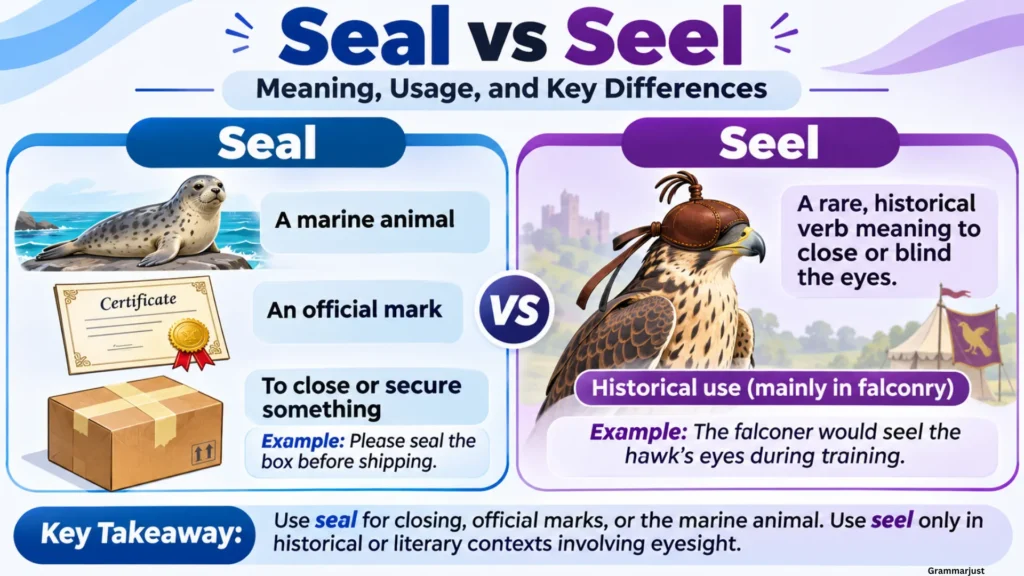
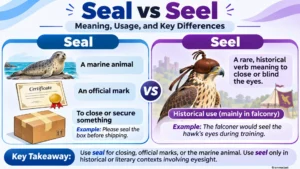
Seal is used for an animal, an official mark, or closing something. Seel is a rare historical word associated with closing the eyes.
Seal or seel? Both are correct English words, but they have different meanings. Seal refers to closing something securely, an official mark, or a marine animal. Seel is a rare historical verb meaning to close or blind the eyes, especially in falconry. The two words sound alike, but their meanings determine which spelling belongs in a sentence.
Seal vs Seel: Key Differences
| Feature | Seal | Seel |
| Meaning | To close securely; an official mark; a marine animal | To close or blind the eyes |
| Part of speech | Noun and verb | Verb |
| Pronunciation | /siːl/ | /siːl/ |
| Usage | Common in modern English | Rare, mainly historical or literary |
| Example | Seal the envelope before mailing it. | The falconer would seel the hawk’s eyes. |
Seal appears in everyday English, while seel is mainly found in older texts and descriptions of historical practices.
What Does Seal Mean?
Seal works as both a noun and a verb. Its meaning depends on what the sentence describes.
Seal as a Verb
As a verb, seal means to close, fasten, or secure something. It can also describe making an agreement final.
Examples:
- Please seal the envelope before sending it.
- The plumber used tape to seal the pipe joint.
- Make sure you seal the food container properly.
- Both companies agreed to seal the deal.
Seal as a Noun
As a noun, seal has three familiar meanings:
1. A marine animal: A seal is a marine mammal with flippers that help it swim.
Example: A seal was resting on the rocks near the shore.
2. An official mark: A seal can be a stamp or symbol used to show authenticity or authority.
Example: The certificate carried the university’s official seal.
3. A protective closure: A seal can prevent air, water, or other substances from passing through an opening.
Example: The damaged rubber seal caused the bottle to leak.
What Does Seel Mean?
Seel is an old English verb associated with closing or blinding the eyes. Historically, falconers used it to describe stitching a hawk’s eyelids closed during training. The word can also refer to closing someone’s eyes in older literature.
According to the Merriam-Webster Dictionary, seel has been used in English since the 15th century.
Seel in Shakespeare’s Writing
William Shakespeare used the word figuratively in Macbeth, Act 3, Scene 2:
“Come, seeling night”
Here, seeling suggests darkness covering or blinding the eyes. The expression uses the historical meaning of seel rather than the everyday meaning of seal.
How to Use Seal and Seel in Sentences
These examples show how context determines the correct word.
| Sentence | Correct word |
| Please seal the box with packing tape. | Seal |
| A seal appeared beside the fishing boat. | Seal |
| The document requires an official seal. | Seal |
| The worker sealed the gap around the window. | Seal |
| The historical guide explained how to seel a falcon. | Seel |
| The poet used seeling to describe darkness covering the eyes. | Seel |
For packages, documents, containers, and marine animals, use seal. Use seel when discussing its historical meaning involving eyesight.
Why Are Seal and Seel Confused?
Seal and seel are homophones, meaning they have the same pronunciation but different spellings and meanings. Both are pronounced /siːl/, rhyming with feel and heel. Their spelling also looks similar because the letter combinations ea and ee produce the same long-e sound in these words. The confusion often comes from hearing the word without knowing its context. For example, someone hearing “seal the box” might mistakenly write “seel the box.”
Common Spelling Mistakes
The most frequent mistake is using seel instead of seal in everyday writing.
Incorrect: Please seel the package before shipping.
Correct: Please seal the package before shipping.
Incorrect: We saw a seel swimming near the beach.
Correct: We saw a seal swimming near the beach.
Incorrect: The document needs an official seel.
Correct: The document needs an official seal.
However, seel should not automatically be corrected to seal when it appears in historical falconry writing or older literature.
Frequently Asked Questions
Is Seel a Real English Word?
Yes, seel is a recognized English verb that historically means to close or blind the eyes. It is rarely used in modern conversation.
Is It Seal or Seel an Envelope?
Seal an envelope is correct. Seal describes closing or securing something, while seel has a historical meaning related to eyesight.
Are Seal and Seel Pronounced the Same?
Yes, both words are pronounced /siːl/. They sound identical, but their meanings and spellings differ.
What Is the Past Tense of Seal and Seel?
The past tense of seal is sealed, while the past tense of seel is seeled.
For example:
- The letter was sealed before mailing.
- The historical account described a hawk whose eyes were seeled.
Is Seel the British Spelling of Seal?
No, seel is not a British alternative to seal. American and British English both use seal for the common meanings of the word.
Conclusion
Use seal when referring to closing something, an official mark, or a marine animal. Seel belongs mainly to historical and literary English, where it describes closing or blinding the eyes. Similar-sounding words can have completely different meanings. Another example is aid or aide, where both words are correct but serve different purposes in a sentence.