Indexes or Indices: Which Is Correct? Meaning and Examples
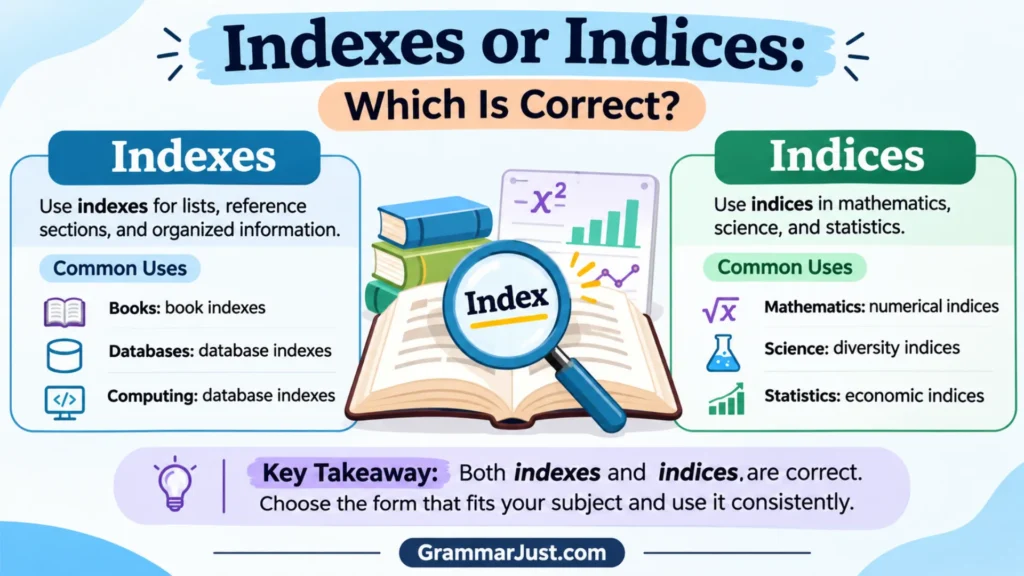
Both indexes and indices are correct. Their usage depends on the subject and writing context.
Indexes and indices are both correct plural forms of index. Use indexes when referring to book reference lists, database records, or organized information. Indices is more common in mathematics, science, and statistics. In finance and programming, both forms are used. The difference is usually a matter of context rather than a strict grammar rule.
Indexes vs Indices: What’s the Difference?
Both words mean more than one index, but their usage differs across subjects. Indexes follows the regular English plural pattern by adding -es. Indices comes from the Latin plural of index.
| Context | Common Usage | Example |
| Books | Indexes | Both textbooks have detailed indexes. |
| Databases | Indexes | The developer added indexes to the database. |
| Mathematics | Indices | The equation contains several indices. |
| Science | Indices | Researchers compared the diversity indices. |
| Stock markets | Both | Several stock market indexes fell yesterday. |
| Programming | Both | The function returns the indices of matching elements. |
These preferences help writers choose the appropriate term, although both plurals are accepted in English.
When Should You Use Indexes?
Indexes commonly refers to lists or systems that organize information and make it easier to find.
Indexes in Books
Many nonfiction books contain an alphabetical index near the end. It lists names, subjects, and their page numbers so readers can locate specific information.
For example:
- The history books contain separate indexes of historical figures.
- She checked the indexes to find references to ancient Egypt.
In publishing, indexes is the usual plural. The word should not be confused with a table of contents, which lists chapters and sections in order.
Indexes in Databases
A database index helps a computer system locate stored records efficiently.
For example:
The administrator created three indexes to speed up customer searches.
The plural indexes is widely used when discussing database structures, although technical naming conventions may vary.
When Should You Use Indices?
Indices is commonly used for mathematical positions, scientific measurements, and statistical indicators.
Indices in Mathematics
Mathematicians use indices to identify positions, distinguish variables, or represent certain mathematical operations.
Consider the expression:
a₁, a₂, a₃
The numbers written below the letter are subscripts that act as indices. They identify different elements in a sequence.
In some mathematics terminology, an index also refers to an exponent. For example, in 2³, the number 3 indicates the power to which 2 is raised.
Indices in Science and Statistics
Scientists often combine measurements into numerical indicators. When discussing several such measurements, indices is a familiar plural.
Examples:
- The study compared air quality indices across five cities.
- Scientists calculated biodiversity indices for different habitats.
- The report examined several economic indices.
Here, each index represents a measurement or calculated indicator rather than an alphabetical list.
Stock Market Indexes or Indices: Which Is Correct?
Both forms are accepted in financial writing.
A stock market index tracks the performance of a particular group of securities. When discussing multiple market measurements, writers may use indexes or indices.
Examples:
- Several stock market indexes declined during Monday’s trading session.
- The analyst compared three international stock indices.
Both sentences are correct.
Financial publications and organizations may follow their own terminology. For instance, S&P Dow Jones Indices uses the Latin plural in its name.
Use the terminology preferred by your publication or organization, especially when preparing financial reports.
Indexes or Indices in Programming?
Programmers use both forms, particularly when referring to array positions. An array index identifies the location of an element. In many programming languages, array positions begin at zero.
For example, consider this JavaScript array:
[“red”, “blue”, “green”]
Its elements occupy positions 0, 1, and 2.
A programmer might write:
- The function returns the indices of matching elements.
- Check the array indexes before accessing the values.
Both expressions describe array positions.
For database structures, indexes is especially common. When referring to array positions, either plural may appear in technical documentation.
The choice of spelling does not affect how the program works.
Why Are Both Indexes and Indices Correct?
The word index comes from Latin, where its plural was indices. English retained that Latin form while also developing indexes according to its regular plural pattern. Over time, both became accepted.
The Merriam-Webster Dictionary confirms that indexes and indices are valid plurals of index. Other English nouns also have alternative plural forms, including appendixes/appendices and matrixes/matrices.
However, not every noun has two accepted plurals. Some follow a fixed spelling rule. For example, potato becomes potatoes, not potatos.
Is Indexes Also a Verb?
Yes, besides being a plural noun, indexes is the third-person singular present-tense form of the verb index.
Compare these sentences:
Plural noun: The library maintains indexes of its historical records.
Verb: The librarian indexes every new publication.
The first sentence refers to several reference lists. The second describes the action of organizing information.
Indices is a plural noun and is not used as a verb.
Indexes or Indices in American and British English
Both spellings are accepted in American and British English.
Indexes is widely used in everyday writing, publishing, and computing. Indices appears frequently in mathematical, scientific, and financial writing in both varieties of English.
For example:
- An American publisher may refer to book indexes.
- A British researcher may discuss statistical indices.
The writer’s subject usually matters more than their country.
Common Mistakes to Avoid
Using indice as the singular: The standard English singular of both indexes and indices is index, not indice.
Assuming indices is always more formal: Indexes is completely acceptable in formal and academic writing when it matches the subject.
Using different plurals inconsistently: If a report uses market indices, keep that terminology throughout unless there is a clear reason to change it.
Treating the forms as having completely separate meanings: Both plurals can refer to the same thing. Their differences largely reflect established usage conventions.
Frequently Asked Questions
What is the correct plural of index?
Both indexes and indices are correct. The preferred form depends on the context.
Is indices grammatically correct?
Yes, indices is a standard English plural used particularly in mathematics, science, statistics, and finance.
What is the singular of indices?
The singular form is index.
Should I use indexes or indices in an essay?
Use indexes for book reference lists and indices for mathematical or statistical measurements. Follow your institution’s style requirements when applicable.
Are stock market indexes and indices the same?
Yes, both terms can refer to multiple stock market measurements. Financial organizations may prefer one spelling.
How do you pronounce indexes and indices?
Indexes is pronounced IN-dek-siz, while indices is commonly pronounced IN-duh-seez.
Conclusion
Both indexes and indices are correct. Indexes is the familiar choice for books, databases, and organized records, while indices is common in mathematics and scientific measurements. Finance and programming accept both forms. Choose the plural that matches your subject and use it consistently. English plural rules are not always predictable. For another example, read our guide to Potatoes or Potatos: Which Spelling Is Correct?, which explains why potatoes is the accepted plural.