Insite or Insight: Correct Spelling, Meaning, and Usage
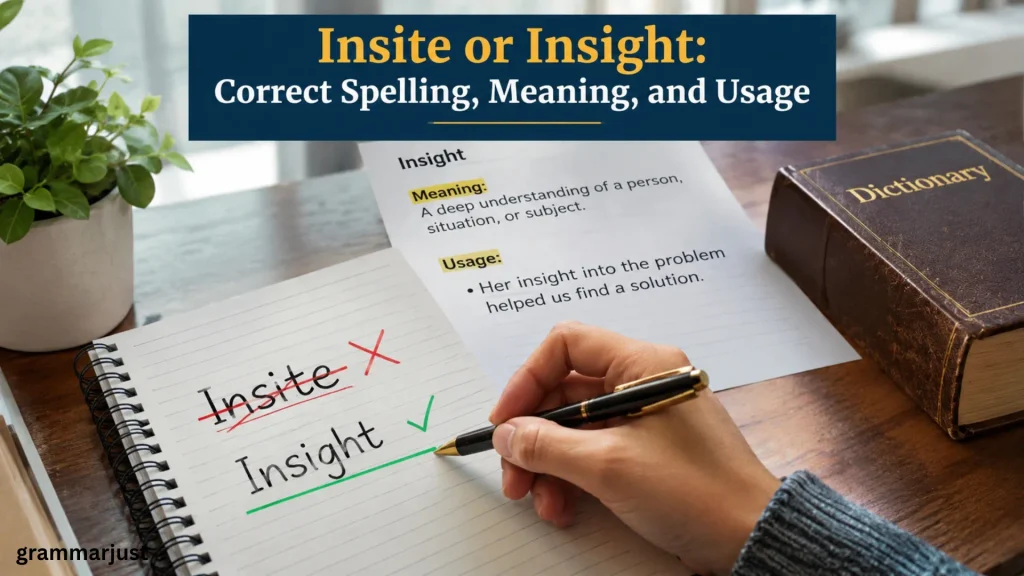
Insight is the correct spelling when referring to clear understanding, while Insite is generally used as a proper name.
Insight is the correct spelling when referring to a clear understanding of something. Insite is usually a misspelling in this context, although it may appear as the official name of a business, product, or organization.
The two spellings look similar, which can make choosing the right one confusing. Understanding how insight is used in everyday English will help you avoid the mistake.
Insite or Insight: Which One is Correct?
Use insight when describing someone’s ability to understand a situation, recognize an important detail, or explain why something happens.
For example:
- Correct: The meeting gave us insight into the customer’s concerns.
- Incorrect: The meeting gave us insite into the customer’s concerns.
The first sentence uses the standard English spelling. The second contains a spelling error because insite does not carry the intended meaning.
Here is a simple comparison:
| Insight | Insite |
| A standard English noun | Not the standard spelling for understanding |
| Means clear or deep understanding | May be used as a proper name |
| Used in conversations, reports, and academic writing | Used when referring to an officially named entity |
| Example: She has valuable insight into the issue. | Example: The software is officially called Insite. |
When your sentence concerns understanding or awareness, insight is the appropriate word.
What Does Insight Mean?
Insight means a clear or deeper understanding of a person, problem, situation, or idea. It often develops when someone looks beyond the obvious facts and recognizes something important. Imagine a shop owner notices that fewer customers are returning to make purchases. Sales records show the decline, but they don’t explain the reason.
After reviewing customer feedback, the owner discovers that delayed deliveries are discouraging repeat orders. That discovery provides insight into customer behavior.
The difference is straightforward: information tells you what is happening, while insight can help you understand why. You can use the word when discussing experiences, research findings, personal relationships, or decisions.
Is Insight a Noun or an Adjective?
Insight is a noun. It refers to understanding or a useful realization.
Example: Her explanation gave me insight into the problem.
The related adjective is insightful, which describes someone or something that demonstrates clear understanding.
Example: The teacher made an insightful observation about the student’s progress.
Insights is also a valid plural noun when referring to several distinct realizations or findings.
Example: The interviews revealed three important insights about employee satisfaction.
Is Insite a Real Word?
Insite isn’t the standard English spelling of insight, but it can be used as a proper name. Companies, software providers, and other organizations sometimes choose distinctive spellings for their names. In those cases, Insite may be intentional rather than an error.
For example:
- The company uses Insite as its official brand name.
- Our team accesses reports through a platform named Insite.
These sentences refer to names, not the English noun meaning understanding.
If you’re writing about an organization or product, check its official spelling before making corrections. For ordinary sentences about knowledge, awareness, or understanding, however, use insight.
How to Use Insight in Everyday English
The meaning of insight remains consistent across different situations. What changes is the subject being understood.
Personal Conversations
You can use insight when someone’s experience helps you see a situation from another perspective.
- Talking with my grandfather gave me insight into our family history.
- Her explanation offered new insight into the disagreement.
Education and Research
In academic writing, insight often describes an understanding gained through observation, analysis, or study.
- The experiment provided insight into how temperature affects plant growth.
- Studying the novel gave students insight into the main character’s decisions.
Workplace Communication
Professionals frequently use insight when discussing customer needs, business challenges, or research findings.
- Customer feedback gave the team insight into recurring delivery problems.
- The monthly report offered useful insights into changing sales patterns.
Each example describes an understanding gained from information or experience rather than information alone.
Insight Into, Insight On, or Insight About?
All three expressions can be grammatically correct, depending on the sentence.
Insight into is especially common when discussing a deeper understanding of a subject.
Example: The interviews provided insight into employee concerns.
Insights on often introduces observations or findings related to a particular topic.
Example: The researcher shared her insights on online learning.
Insight can describe a realization or understanding concerning something.
Example: The conversation gave him new insight about his behavior.
Although these expressions overlap in meaning, insight into is generally a natural choice when describing a deeper understanding of a problem, person, or situation.
Why Do People Confuse Insite and Insight?
The confusion mainly comes from pronunciation.
Insight is pronounced approximately IN-site, with the emphasis on the first syllable.
Because the second syllable sounds like site, people sometimes write insite instead.
However, the correct spelling includes sight.
A simple way to remember it is:
In + sight = insight
Think of sight as seeing something and insight as understanding something more clearly.
Other familiar words, including eyesight, hindsight, and foresight, contain the same spelling.
This connection can help you remember the silent gh in insight.
Insight vs Incite: An Important Difference
Incite is another English word that sounds similar to insight, but the two have different meanings and grammatical functions.
Insight is a noun describing understanding.
Example: The report gave us insight into the problem.
Incite is a verb meaning to provoke or encourage someone to take action, often in a negative context.
Example: The remarks could incite violence.
There is also a pronunciation difference. Insight is stressed on the first syllable, while incite is stressed on the second. Remember that understanding a situation and provoking an action are two different ideas.
Frequently Asked Questions
Is it great insite or great insight?
The correct expression is great insight when praising someone’s understanding or judgment.
Example: She showed great insight during the discussion.
What does “gain insight” mean?
To gain insight means to develop a clearer understanding of something through learning, observation, or experience.
Example: Working with experienced teachers helped her gain insight into classroom management.
Can insight be plural?
Yes, Insights is the plural form when referring to separate observations, discoveries, or realizations.
Example: The survey produced several useful insights.
Is insight spelled differently in American and British English?
No, Both American and British English use the spelling insight.
What is another word for insight?
Depending on the sentence, suitable alternatives include understanding, awareness, perception, and discernment. These words have overlapping meanings but are not interchangeable in every context.
Final Thoughts
When referring to understanding or a meaningful realization, the correct word is insight. The spelling insite generally belongs to proper names rather than ordinary vocabulary. Remember the connection with sight, and use insight when describing what someone has learned or come to understand.