Analysis vs Analyses: What’s the Difference?
Analysis is singular, while analyses is the plural form.
The words analysis and analyses look similar, but they have different meanings and uses. The main difference is that analysis is the singular form, while analyses is its plural form.
Use analysis when referring to one detailed examination of something. Use analyses when referring to two or more examinations.
For example:
- Singular: The analysis is complete.
- Plural: The analyses are complete.
Understanding the difference between these words will help you write more accurately in academic, professional, and everyday English.
Analysis vs Analyses: Quick Answer
| Word | Grammatical form | Meaning | Example |
| Analysis | Singular noun | One detailed examination | The analysis is accurate. |
| Analyses | Plural noun | Two or more examinations | The analyses are accurate. |
Quick rule: Use analysis for one examination and analyses for more than one. The singular noun takes a singular verb, such as is or was, while the plural noun takes a plural verb, such as are or were.
What Does Analysis Mean?
Analysis is a singular noun that means a detailed examination of something to understand its parts, meaning, structure, or results.
An analysis may involve examining information, studying a problem, interpreting data, or evaluating a situation.
Examples of Analysis in Sentences
- The analysis is based on the latest data.
- Her analysis of the report was detailed and accurate.
- We need an analysis of the survey results.
- The financial analysis revealed a possible risk.
- His analysis helped the team understand the problem.
In each sentence, analysis refers to one examination or process of examining something.
How to Pronounce Analysis
Analysis is commonly pronounced uh-NAL-uh-sis.
It ends with the sound “sis.”
What Does Analyses Mean?
Analyses is the plural form of analysis. It refers to two or more examinations, investigations, or detailed studies.
Use analyses when discussing multiple reports, studies, tests, or evaluations.
Examples of Analyses in Sentences
- The analyses are ready for review.
- The researchers compared three analyses.
- These analyses provide useful insights into the problem.
- The financial analyses were reviewed by the management team.
- Several analyses of the survey data produced similar results.
In these examples, analyses refers to more than one examination.
How to Pronounce Analyses
When used as the plural noun, analyses is commonly pronounced uh-NAL-uh-seez.
Unlike analysis, it ends with a “seez” sound. The difference in pronunciation can help you distinguish the two words when speaking.
Key Differences Between Analysis and Analyses
Although the two words share the same root, their grammatical roles differ.
| Feature | Analysis | Analyses |
| Form | Singular | Plural |
| Meaning | One examination | More than one examination |
| Example with a verb | The analysis is useful. | The analyses are useful. |
| Past-tense example | The analysis was completed. | The analyses were completed. |
| Quantity | One | Two or more |
Remember that the correct verb depends on whether you are using the singular noun analysis or the plural noun analyses.
Analysis vs Analyses: Examples in Sentences
Comparing similar sentences makes the difference easier to remember.
1. Present tense
- Singular: The analysis shows a significant change.
- Plural: The analyses show significant changes.
2. Past tense
- Singular: This analysis was prepared by the research team.
- Plural: These analyses were prepared by the research team.
3. Research and data
- Singular: The analysis of the data is complete.
- Plural: The analyses of the data are complete.
4. Business and finance
- Singular: Our analysis revealed an important pattern.
- Plural: Our analyses revealed several important patterns.
Notice how the noun and verb change together: analysis shows becomes analyses show, and analysis is becomes analyses are.
Why Is the Plural of Analysis “Analyses”?
The plural of analysis is analyses, not analysises. This is because the word follows a plural pattern found in several English words derived from Greek.
Words ending in -sis often change to -ses in the plural.
Examples include:
- Analysis → Analyses
- Thesis → Theses
- Crisis → Crises
- Basis → Bases
- Hypothesis → Hypotheses
These words do not form their plurals by simply adding -s or -es to the end. Their spelling changes, so it is useful to learn each singular and plural form together.
Incorrect: The report contains three analysises.
Correct: The report contains three analyses.
Can “Analyses” Also Be a Verb?
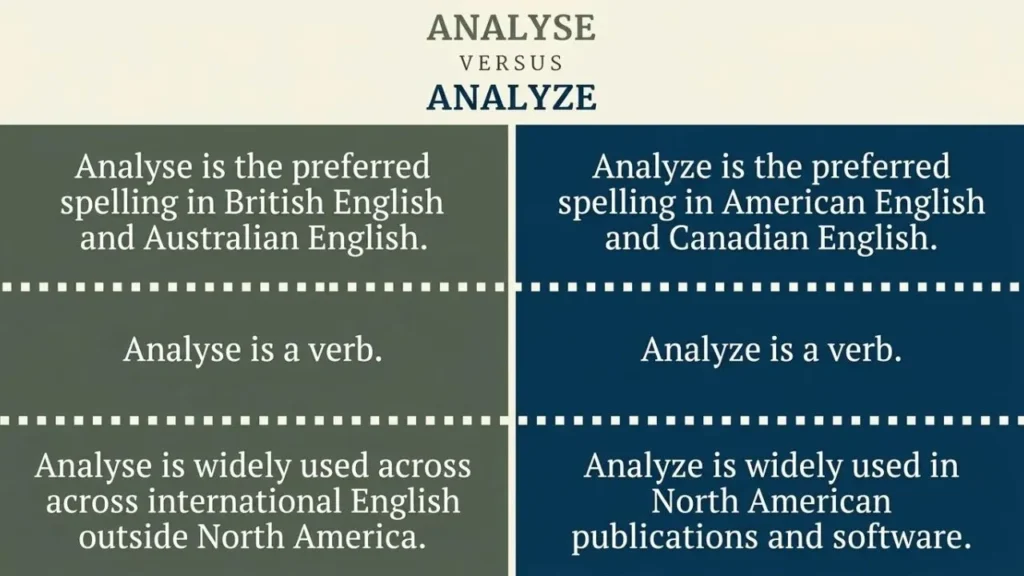
Yes. In addition to being the plural noun of analysis, analyses can be a verb in British English. It is the third-person singular form of analyse, meaning to examine something carefully.
For example:
- British English: She analyses the survey results.
- American English: She analyzes the survey results.
American English generally uses analyze, while British English commonly uses analyse.
Compare these examples:
- Noun: The analyses are ready for review.
- Verb: She analyses the results every month.
The context and sentence structure help you identify whether analyses is being used as a noun or a verb.
Common Mistakes to Avoid
Here are four common mistakes and their correct forms.
Mistake 1: Using a plural verb with “analysis”
Incorrect: The analysis are complete.
Correct: The analysis is complete.
Why? Analysis is singular.
Mistake 2: Using a singular verb with “analyses”
Incorrect: The analyses is ready.
Correct: The analyses are ready.
Why? Analyses is plural when used as a noun.
Mistake 3: Writing “analysises” as the plural
Incorrect: We completed two analysises.
Correct: We completed two analyses.
Why? The correct plural follows the -sis to -ses pattern.
Mistake 4: Using “analysis” for multiple examinations
Incorrect: The researchers compared three analysis.
Correct: The researchers compared three analyses.
Why? A plural quantity requires the plural noun analyses.
Practice Quiz: Analysis or Analyses?
Choose the correct word to complete each sentence.
1. The ___ of the report is complete.
- A. analysis
- B. analyses
2. The researchers conducted several ___ of the results.
- A. analysis
- B. analyses
3. These ___ are useful for understanding the problem.
- A. analysis
- B. analyses
4. Her ___ of the evidence was convincing.
- A. analysis
- B. analyses
Answers and Explanations
- Analysis — The sentence refers to one examination, so the singular noun is correct.
- Analyses — The word several indicates more than one examination.
- Analyses — The plural verb are signals that a plural noun is needed.
- Analysis — The sentence refers to one examination of the evidence.
FAQs
Is analyses singular or plural?
Analyses is the plural form of the noun analysis. For example, “The analyses are complete” refers to multiple examinations.
What is the plural of analysis?
The plural of analysis is analyses. The word changes its ending from -sis to -ses.
Is “analysises” a correct word?
No. Analysises is not the standard plural form. The correct spelling is analyses.
What is the difference in pronunciation between analysis and analyses?
Analysis ends with a “sis” sound, while the plural noun analyses ends with a “seez” sound. You can use this difference to help distinguish them when speaking.
Can analyses be used as a verb?
Yes. In British English, analyses can be the verb form used with he, she, or it, as in “She analyses the results.” American English generally uses analyzes in this context.
Should I write “data analysis” or “data analyses”?
Use data analysis when referring to one examination or the general process of examining data. Use data analyses when referring to multiple separate examinations.
For example:
- Data analysis is an important research skill.
- The researchers compared two data analyses.
Conclusion
The difference between analysis and analyses is simple once you remember their grammatical forms. Analysis is the singular noun for one detailed examination, while analyses is the plural noun for two or more examinations.
Remember these examples:
- One analysis is complete.
- Two analyses are complete.
Also, remember that analyses can function as a verb in British English, while American English generally uses analyzes. With these rules and examples, you can choose the correct word more confidently in your writing.