Truly or Truely: Which Spelling Is Correct?
Truly is the correct spelling, while truely is incorrect. Learn the spelling rule with examples.
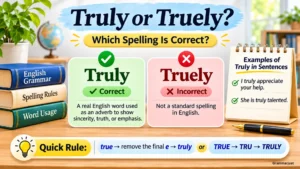
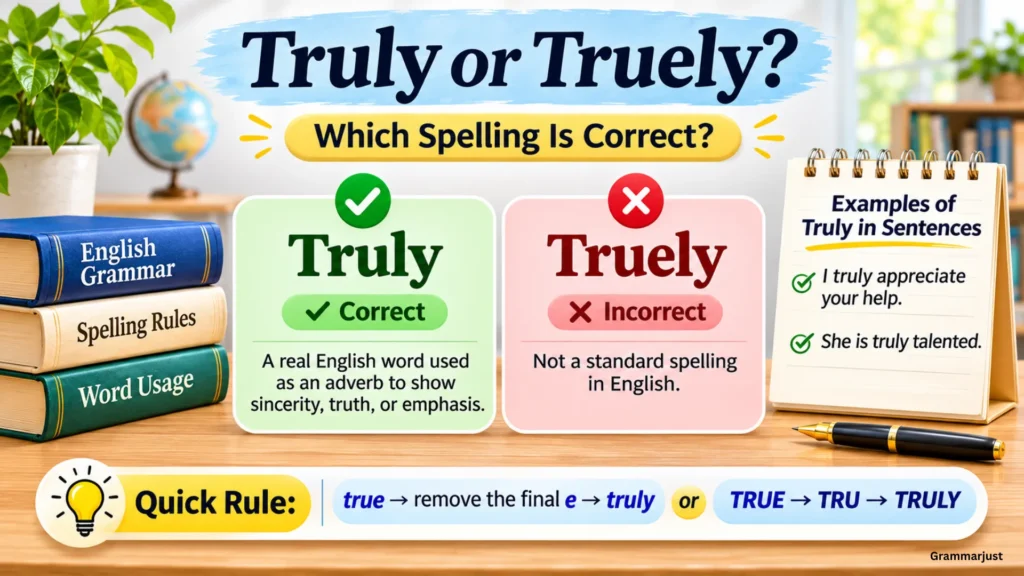
Truly is the correct spelling, while truely is incorrect in standard English. The word comes from true, but its final e is dropped before adding -ly. It is used to express sincerity, honesty, accuracy, or emphasis.
For example:
- ✅ I truly appreciate your help.
- ❌ I truely appreciate your help.
Why Is Truly Correct Instead of Truely?
The confusion comes from the adjective true. Adding -ly usually turns an adjective into an adverb, but the spelling of the original word may change.
For truly, the final e disappears:
True − e + ly = Truly
Not every adjective follows this pattern.
| Adjective | Adverb |
| True | Truly |
| Nice | Nicely |
| Complete | Completely |
| Whole | Wholly |
| Gentle | Gently |
Notice that nice and complete keep their final e, while true and whole lose it. English spelling changes depend on the individual word and its suffix. A similar spelling change occurs when glue becomes gluing. You can see how that word changes in our Gluing or Glueing spelling guide.
What Does Truly Mean?
Truly is an adverb that describes something as genuine, sincere, or accurate. It can also strengthen a statement.
According to the Merriam-Webster Dictionary, the word has meanings connected to sincerity, truthfulness, and emphasis. Its meaning becomes clearer in different sentences.
Expressing sincere feelings
- I truly regret what happened.
- We are truly grateful for your kindness.
Here, truly shows that the feelings are genuine.
Describing accuracy or truth
- Is the information truly accurate?
- His actions did not truly reflect his beliefs.
In these examples, the word refers to whether something represents the facts.
Adding emphasis
- The performance was truly remarkable.
- This is a truly difficult decision.
Here, truly strengthens the description.
Truly or Truely: Correct Sentence Examples
The spelling remains truly regardless of its position in a sentence.
| Incorrect | Correct |
| She is truely talented. | She is truly talented. |
| I am truely sorry. | I am truly sorry. |
| This is truely surprising. | This is truly surprising. |
| He truely deserves recognition. | He truly deserves recognition. |
The extra e is the only spelling error in these examples.
Is It Yours Truly or Yours Truely?
Yours truly is the correct expression. It is used as a closing in letters and sometimes in professional emails.
For example:
Yours truly,
Michael
It can also be an informal way to refer to yourself.
Example: “Who prepared the presentation? Yours truly!”
In both uses, truely would be incorrect.
How to Remember the Spelling of Truly
Start with true, remove the final e, and add -ly.
TRUE → TRU → TRULY
The word contains only one l and no e.
Remembering this spelling change can help you avoid writing truely, trully, or truley.
Frequently Asked Questions
Is Truely a Word?
Truely is considered a spelling mistake in modern standard English. Use truly instead.
Is Truly Correct in British and American English?
Yes, truly is the standard spelling in both British and American English.
Is Truly an Adjective or an Adverb?
Truly is an adverb. Its adjective form is true.
- Adjective: Her answer is true.
- Adverb: She truly understands the problem.
What Is Another Word for Truly?
Depending on the context, truly can be replaced with genuinely, sincerely, really, or honestly.
For example: “I truly appreciate your honesty” can also be written as “I genuinely appreciate your honesty.”
Conclusion
Truly is the only standard spelling of the adverb formed from true. The final e is removed before adding -ly, so truely is incorrect. Whether you are expressing sincere feelings, emphasizing a statement, or signing a letter with yours truly, the spelling stays the same.