Gluing or Glueing: Which Spelling Is Correct?
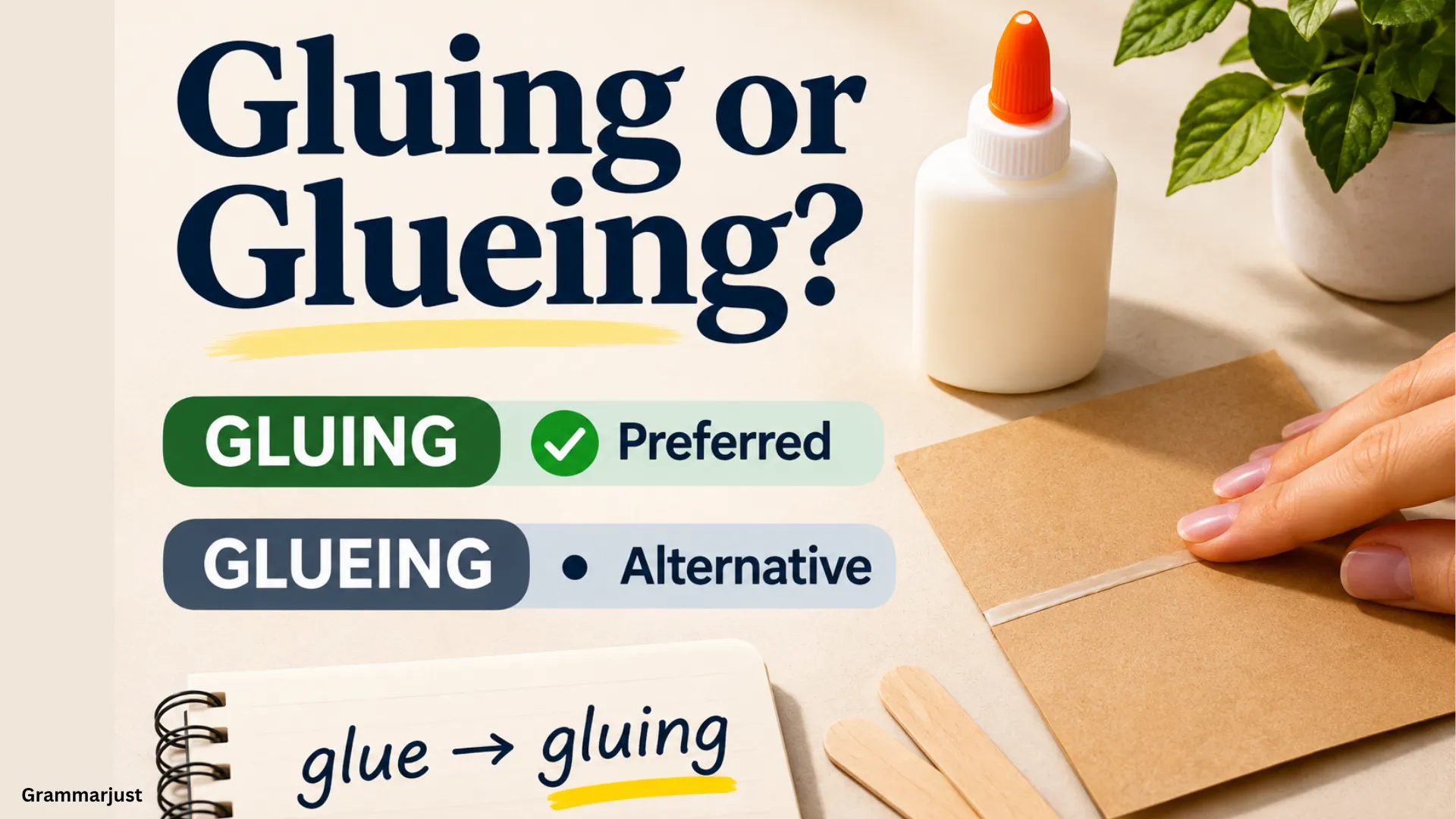
Gluing is the preferred spelling, while glueing is a less common alternative recognized by some dictionaries.
Gluing is the preferred spelling in modern English. It describes joining things together with glue, such as paper, wood, or fabric. Although glueing is also listed in some dictionaries, gluing is the more familiar choice for everyday writing, schoolwork, and professional documents.
The difference comes from how English verbs change when -ing is added.
Gluing and Glueing: Spelling and Meaning
Both words describe the same action. Their difference is in spelling, not meaning. Gluing follows the usual English spelling rule by removing the final e from glue before adding -ing.
Glueing keeps the original word unchanged and adds -ing at the end. This version is recognized as an alternative, although it is less commonly preferred.
Here is a simple comparison:
| Gluing | Glueing |
| Preferred spelling | Alternative spelling |
| Follows the usual silent-e rule | Keeps the final e |
| Recommended for general writing | Less commonly used |
| Suitable in American and British English | Also recorded in English dictionaries |
For a school assignment, email, article, or workplace document, gluing is the recommended form.
Why Does Glue Become Gluing?
Many English verbs ending in a silent e lose that letter when -ing is added.
For example:
- Make → Making
- Write → Writing
- Bake → Baking
- Move → Moving
- Glue → Gluing
The same rule explains why we write gluing rather than keeping the complete word glue.
Glue − e + ing = Gluing
Dropping the final e does not change the pronunciation. Both spellings are pronounced like “GLOO-ing.”
This pattern does have exceptions. For example, dye becomes dyeing to avoid confusion with dying. However, the regular spelling pattern is the appropriate one to follow when writing gluing.
Is Glueing a Real Word?
Yes, Glueing is a recorded alternative spelling, not simply a word invented by people who misunderstand English grammar.
The Cambridge Dictionary includes both glueing and gluing as present participles of the verb glue.
That does not mean both forms are equally preferred. A dictionary can recognize an alternative spelling while another form remains the standard recommendation for general use. When you want straightforward spelling that readers will recognize, gluing is the safer choice.
Gluing in American and British English
There is no need to change gluing to glueing when writing for a British audience. Gluing is appropriate in both American and British English. Although some dictionaries list the alternative form, glueing is not a required British spelling.
This differs from words such as color and colour, where the spelling preference is strongly associated with a particular variety of English. Whether you are preparing a document for readers in the United States or the United Kingdom, using gluing keeps your writing clear and consistent.
Examples of Gluing in Sentences
The word gluing can describe an action happening now or an activity in general.
Here are some natural examples.
Craft activities
- Emma is gluing dried flowers onto a greeting card.
- The students spent their art lesson gluing paper decorations.
Home repairs
- Daniel is gluing the loose corner of the picture frame.
- Before gluing the broken pieces, wipe away any dust.
Workplace tasks
- The employee is gluing product labels onto cardboard boxes.
- Gluing the panels evenly helps produce a neat finish.
These examples show that gluing works in different situations without changing its spelling.
Glue, Glued, and Gluing: Different Verb Forms
The verb glue changes depending on when an action happens and how it is used in a sentence.
| Word | Example |
| Glue | Please glue the two pieces together. |
| Glues | He glues fabric onto the wooden board. |
| Glued | We glued the damaged cover yesterday. |
| Gluing | They are gluing the final pieces now. |
One detail worth remembering is that glued keeps the original e because only -d is added.
With gluing, the e is normally removed before adding -ing.
Gluing as a Verb and a Noun
Gluing can also serve two grammatical purposes.
As part of a verb phrase:
“She is gluing the handle back onto the mug.”
As a gerund, which functions like a noun:
“Gluing requires a steady hand.”
In both cases, the spelling stays the same.
FAQs
Is glueing a spelling mistake?
Not necessarily. Some respected dictionaries recognize glueing as an alternative. Nevertheless, gluing is the preferred spelling for ordinary writing.
What is the correct spelling of gluing?
Write gluing. Remove the final e from glue and add -ing.
Does gluing mean the same thing as sticking?
The two words can describe similar actions. Gluing specifically refers to joining materials with glue or an adhesive, while sticking has a wider range of meanings.
How do you pronounce gluing?
Gluing is pronounced GLOO-ing, with two syllables. Keeping or removing the written e does not change the pronunciation.
What is the past tense of gluing?
The past tense of glue is glued.
For example: “She glued the torn page back into the book.”
Final Thoughts
When choosing between gluing or glueing, use gluing for clear, standard writing. It follows the usual English spelling pattern and works in both American and British English. Glueing is a recognized alternative in some dictionaries, but gluing remains the more practical choice for most readers.
2 thoughts on “Gluing or Glueing: Which Spelling Is Correct?”