Tying or Tieing: Which Spelling Is Correct?
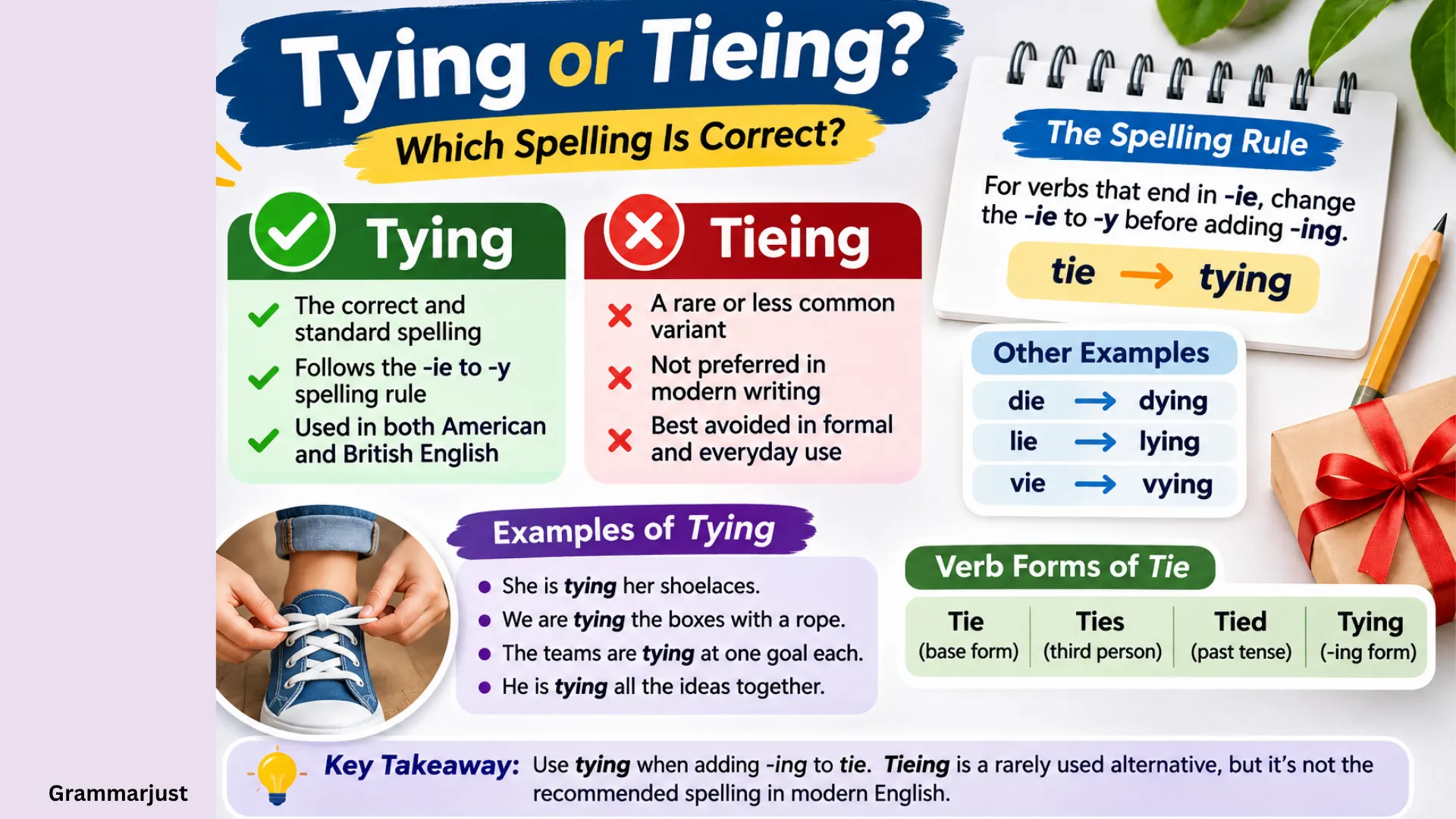
Tying is the standard spelling. Learn how tie changes to tying and why tieing is an uncommon alternative.
Tying is the standard spelling in modern English. It is the -ing form of the verb tie, which means fastening something with a knot, connecting things, or matching another person’s score. Although tieing is recorded as a rare alternative, tying is the spelling you should use in everyday and professional writing.
The difference comes from an English spelling rule that changes -ie to -y before adding -ing.
Tying vs Tieing: Understanding the Difference
Both spellings refer to the same action, but they are not equally common. Tying follows the standard English spelling pattern. Tieing keeps the original letters of tie and simply adds -ing, making it an uncommon alternative.
| Tying | Tieing |
| Standard spelling | Rare alternative |
| Changes -ie to -y | Keeps the original -ie |
| Preferred in American and British English | Not generally preferred |
| Recommended for everyday writing | Best avoided in most writing |
For school assignments, emails, articles, and instructions, choose tying.
Why Does Tie Become Tying?
English verbs that end in -ie generally change those letters to -y when the -ing ending is added.
The word tie follows this pattern:
Tie → Ty → Tying
The same change happens with several other verbs.
| Original verb | -ing form |
| Die | Dying |
| Lie | Lying |
| Vie | Vying |
| Tie | Tying |
This is different from words such as make and write, where only the final silent e is removed.
With tie, the complete -ie ending changes to -y.
Remembering this distinction makes the spelling easier to understand.
Is Tieing a Real Word?
Tieing is an uncommon spelling, but it has appeared in recognized dictionaries.
The Merriam-Webster Dictionary identifies tying as the present participle of tie. The Cambridge Dictionary also uses this form. The Collins English Dictionary records tieing as a variant in its American English entry. However, dictionary recognition does not mean a spelling is recommended for general use.
Tying remains the appropriate choice for readers who want familiar, standard English.
Different Meanings of Tying With Examples
The word tying is not limited to making knots. Its meaning changes according to the situation.
Fastening Objects
When someone secures two things with string, rope, or another flexible material, the action is called tying.
Examples:
- Sarah is tying a ribbon around the birthday present.
- The sailor is tying the boat to the dock.
- Jake is tying his shoelaces before going outside.
Matching a Score
In competitions, tying can describe reaching the same score or position as another player or team.
Examples:
- The visitors are tying the score with a late goal.
- Mia is tying her opponent for first place.
Here, the word has nothing to do with a physical knot.
Connecting Ideas
Tying can also describe bringing separate pieces of information together.
Examples:
- The writer is tying the main ideas together in the final paragraph.
- The company is tying employee rewards to performance.
The spelling stays the same in each meaning.
Tie, Ties, Tied, and Tying
The verb tie has different forms depending on how it is used in a sentence.
| Verb form | Sentence example |
| Tie | Please tie the package securely. |
| Ties | He ties his shoes before school. |
| Tied | They tied the rope yesterday. |
| Tying | She is tying a bow right now. |
Use tied when describing a completed past action.
Use tying for an ongoing action or when referring to the activity itself.
For example:
- Verb phrase: He is tying a knot.
- Gerund: Tying knots requires practice.
In the second example, tying functions as a noun.
Common Expressions That Use Tying
English includes several expressions in which tying has a broader meaning.
Tying the knot means getting married.
“After five years together, the couple is tying the knot next month.”
Tying up loose ends means completing unfinished tasks.
“We are tying up loose ends before submitting the report.”
Tying something together means connecting separate parts into a complete whole.
“The final chapter succeeds in tying the story together.”
These expressions always use the standard spelling tying in ordinary modern English.
Tying in American and British English
There is no need to change the spelling based on whether your audience follows American or British English.
Tying is standard in both varieties.
Although tieing appears as a rare alternative in some references, it is not a required British spelling or a common American preference. Writing tying keeps your sentences consistent for readers in both countries.
Frequently Asked Questions
Is it tying or tieing your shoes?
The standard expression is tying your shoes. The word follows the rule of changing -ie to -y before adding -ing.
Is tieing grammatically incorrect?
Tieing is a recorded variant, but it is not the recommended form in standard writing. Use tying instead.
How do you pronounce tying?
Tying is pronounced TIE-ing, with two syllables. Its phonetic pronunciation is /ˈtaɪ.ɪŋ/.
Is it tying or tieing the knot?
Write tying the knot. The expression can refer to making a knot or getting married.
What is the difference between tying and tied?
Tying describes an ongoing action or an activity. Tied is the past tense and past participle of tie.
Is untying spelled with a y?
Yes. Untie becomes untying, following the same change from -ie to -y before -ing.
Final Answer
Between tying or tieing, tying is the standard and preferred spelling. It works when describing knots, equal scores, personal connections, and common expressions.
To remember the spelling, change -ie in tie to -y, then add -ing.
Although tieing is recorded as a rare alternative, tying is the better choice for clear, consistent English.
Also Read:
1 thought on “Tying or Tieing: Which Spelling Is Correct?”