Begun or Began: Difference, Correct Usage, and Examples
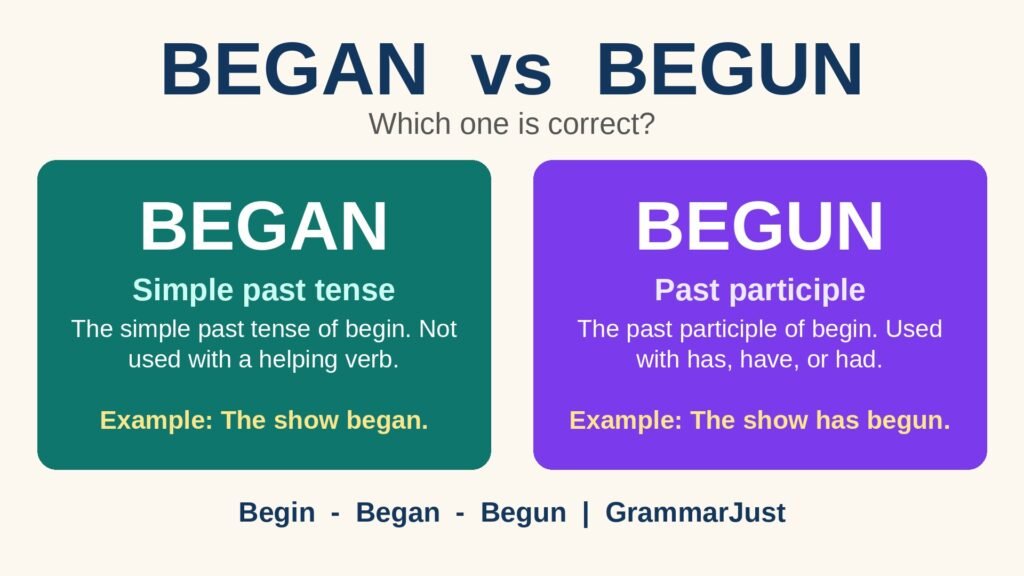
Began is the simple past tense of begin while begun is its past participle.
Begun or began: which one is correct? Both come from the verb begin, but they serve different grammatical purposes. Began is the simple past tense of begin while begun is its past participle, commonly used after has, have, or had.
Compare these sentences:
Correct: The meeting began at 10 a.m.
Correct: The meeting has begun.
Incorrect: The meeting has began.
The correct choice depends on the verb tense and sentence structure, not just whether the action happened in the past.
Begun vs Began: Understanding the Difference
Begin is an irregular verb. Instead of adding -ed to form its past tense, its spelling changes.
| Verb Form | Correct Word | Sentence Example |
|---|---|---|
| Present (base form) | Begin | Classes begin at eight. |
| Simple past | Began | Classes began yesterday. |
| Past participle | Begun | Classes have begun. |
The distinction is straightforward: began describes a past start using the simple past tense. Begun appears when the grammar requires a past participle.
When to Use Began
Use began when identifying when an activity, event, or situation started in the past.
For example:
She began her new job on Monday.
The rain began just before sunset.
We began discussing the problem after lunch.
Their friendship began during college.
Construction began in early March.
Notice that none of these sentences needs has, have, or had before the verb.
Does Began Mean the Action Is Finished?
Not necessarily.
Consider this sentence:
“James began learning French last year.”
James might still be learning French today. Began tells us when his learning started, not when it ended.
This distinction matters because the simple past tense places the beginning of an action in the past without automatically describing its completion.
When to Use Begun
Begun is the past participle of begin. It commonly appears in perfect tenses with has, have, and had.
Has Begun
Use has begun with a singular third-person subject, such as he, she, it, or the event.
Examples:
The movie has begun.
Sarah has begun preparing for her exams.
The company has begun accepting applications.
Have Begun
Use have begun with I, you, we, they, and plural subjects.
Examples:
I have begun writing my report.
We have begun planning the wedding.
The students have begun their assignments.
Had Begun
Had begun places the beginning of an action before another past event or reference point.
Examples:
The presentation had begun before we arrived.
She had begun cooking when the doorbell rang.
By noon, the workers had begun repairing the bridge.
The helping verb changes, but begun remains the past participle in all three constructions.
Can Begun Be Used Without Have, Has, or Had?
Yes, Begun can also appear in passive voice sentences.
For example:
“The investigation was begun in January.”
This construction is grammatically correct although “The investigation began in January” usually sounds more natural.
Therefore, begun is not limited to sentences containing has, have, or had.
Common Began and Begun Mistakes
Most errors happen when someone puts began after a perfect-tense helping verb or uses begun as the simple past tense.
| Incorrect Sentence | Correct Sentence |
|---|---|
| I have began studying. | I have begun studying. |
| She begun working yesterday. | She began working yesterday. |
| The match has began. | The match has begun. |
| They had began eating. | They had begun eating. |
| It begun raining last night. | It began raining last night. |
A useful editing check is to look at the words immediately before the verb. If the sentence uses has, have, or had to form a perfect tense, choose begun.
For a straightforward statement about when something started in the past, use began.
How to Remember Began and Begun
Remember the three forms together:
Begin → Began → Begun
Use these two sentences as a reference:
“I began the assignment yesterday.”
“I have begun the assignment.”
The first describes a past beginning. The second uses the present perfect tense.
Checking whether your sentence needs the simple past or a past participle is more reliable than choosing whichever word sounds familiar.
Began or Begun in Everyday Sentences
The same grammar rule applies to conversations, emails, schoolwork, and professional writing.
| Situation | Example |
|---|---|
| School | The teacher began the lesson at nine. |
| Workplace | Our team has begun testing the software. |
| Travel | The journey began before sunrise. |
| Personal plans | I have begun saving for a car. |
| Past sequence | The guests had begun arriving before dinner. |
These examples show why both words are necessary. Each expresses a beginning, but the sentence structure determines which form is correct.
FAQs
Is It “I Began” or “I Begun”?
“I began” is correct when using the simple past tense.
For example: “I began exercising last week.”
To use begun, add an appropriate helping verb: “I have begun exercising.”
Is It “Has Began” or “Has Begun”?
Has begun is correct.
For example: “The ceremony has begun.”
Has takes the past participle begun, not the simple past form began.
Is It “Had Began” or “Had Begun”?
Had begun is correct.
For example: “The train had begun moving before he reached the platform.”
Is It “The Work Began” or “The Work Has Begun”?
Both are correct:
“The work began on Tuesday” identifies when it started.
“The work has begun” uses the present perfect tense to report that the work has started.
Is “Where It All Began” Grammatically Correct?
Yes, “Where it all began” correctly uses the simple past tense to refer to the place or circumstances in which something started.
For example: “This is the house where it all began.”
Final Takeaway
Began is the simple past tense of begin. Begun is the past participle used in perfect tenses and certain passive constructions. Use began to describe when something started in the past. Use begun after has, have, or had when forming perfect tenses. The pattern to remember is begin, began, begun. For a similar verb-form confusion, see Eying or Eyeing.