Busing or Bussing: Which Spelling Is Correct?
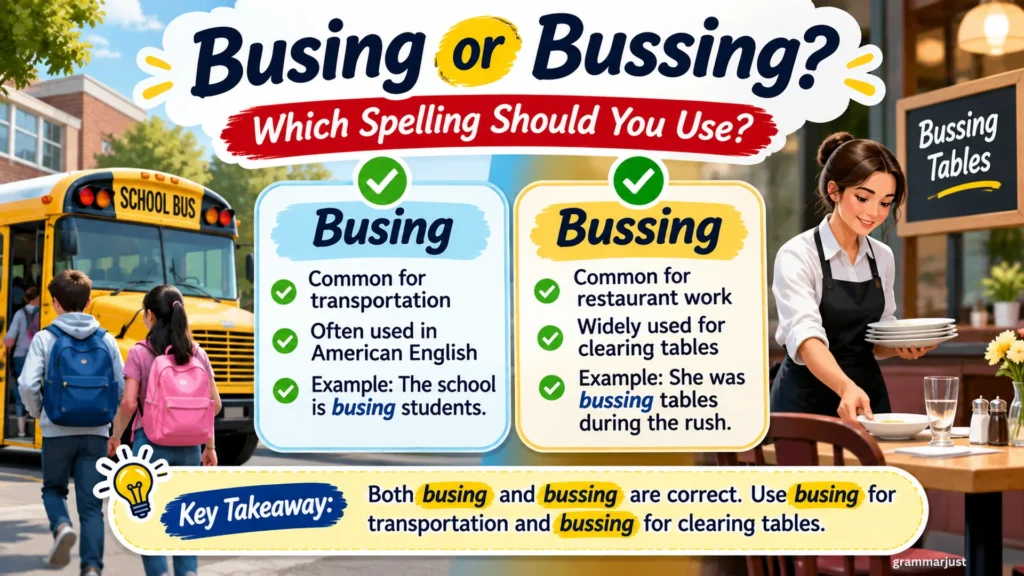
Busing commonly refers to transporting people by bus, while bussing is often used for clearing restaurant tables. Both spellings are accepted.
Busing and bussing are both correct English spellings, but their common usage differs. Busing is generally preferred in American English when talking about transporting people by bus. Bussing is especially common when restaurant workers clear dishes from tables. However, both spellings are accepted variants, so the choice depends on the context and writing style.
Busing vs Bussing: What’s the Difference?
Both words come from the verb bus and have the same pronunciation. The difference is the number of s letters and how each spelling is commonly used.
| Feature | Busing | Bussing |
| Spelling | One s | Double ss |
| Common context | Transportation | Restaurant table clearing |
| Transportation usage | Preferred in American English | Accepted alternative |
| Restaurant usage | Also used | Commonly preferred |
| Pronunciation | BUH-sing | BUH-sing |
Neither spelling is limited to one meaning. However, using the more familiar form makes a sentence easier to understand.
When Should You Use Busing?
Use busing when describing people being transported by bus, particularly in American English.
Examples:
- The school is busing students to another campus.
- The company started busing employees from a nearby parking lot.
- The city arranged busing for residents during the evacuation.
The word also appears in American educational history. School busing can refer to programs that transported students between schools to address racial segregation.
For example:
- The district introduced a school busing program in the 1970s.
The Merriam-Webster Dictionary identifies busing as the main spelling and recognizes bussing as a variant.
What Does Bussing Tables Mean?
Bussing tables means removing used dishes, glasses, and utensils from restaurant tables and preparing the space for the next customers.
A restaurant employee who performs this work is commonly called a busser.
Examples:
- Sarah was bussing tables during the lunch rush.
- The restaurant hired another employee to help with bussing.
- He finished bussing the table before the next guests arrived.
You may also see busing tables. Both spellings are used for this activity, although bussing tables is particularly familiar in restaurant terminology.
Why Are Busing and Bussing Spelled Differently?
The two spellings reflect accepted ways of adding -ing to the verb bus.
- Bus + ing = Busing
- Bus + sing = Bussing
Some English verbs double their final consonant before adding -ing, such as run → running. However, both the single-s and double-s forms have become established for bus.
The same variation appears in the past tense:
| Present form | Past form |
| Busing | Bused |
| Bussing | Bussed |
For example:
- The school bused students to the sports event.
- The visitors were bussed to their hotel.
Both past-tense spellings are recognized. Using one spelling style consistently is usually the better choice within the same document.
Busing or Bussing in American and British English
American English generally favors busing and bused for transportation. The doubled forms, bussing and bussed, are also recognized.
British English permits both spellings, with doubled forms appearing in transportation-related writing as well.
These differences reflect usage preferences rather than completely separate spelling rules. For American transportation writing, busing is a reliable choice. For restaurant table clearing, bussing is particularly familiar.
Frequently Asked Questions
Is bussing grammatically correct?
Yes. Bussing is an accepted spelling used in restaurant work and transportation contexts.
Is it busing or bussing tables?
Both spellings are used, but bussing tables is especially common in restaurant terminology.
Should I write busing or bussing students?
Busing students is generally preferred in American English. Bussing students is also an accepted variant.
Is the past tense bused or bussed?
Both are correct. Bused is commonly preferred in American transportation writing, while bussed is another accepted form.
Conclusion
Busing and bussing are both valid spellings. Use busing for transportation in standard American English and bussing when describing restaurant table clearing. Neither form is universally incorrect. For more explanations of confusing English spellings and their correct usage, explore GrammarJust.