Criteria vs Criterion: The Singular–Plural Rule Explained
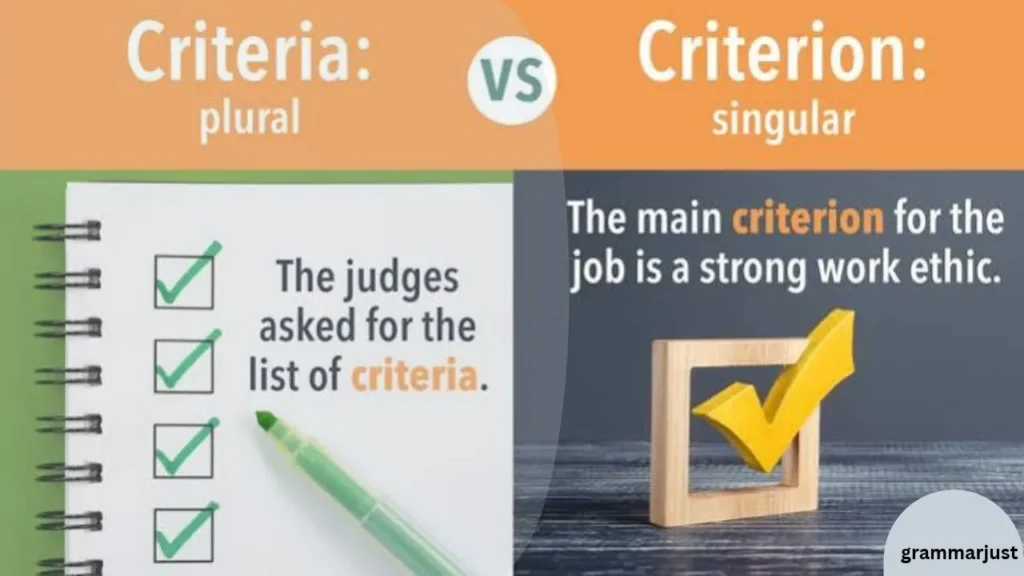
Criterion is singular, while criteria is the plural form.
Have you ever wondered whether to write criteria or criterion when referring to a standard or requirement? Although these words have almost the same meaning, they are not interchangeable in traditional English grammar.
Criterion is the singular form, while criteria is its standard plural form. Use criterion when referring to one standard and criteria when discussing two or more.
However, criteria is also sometimes used as a singular noun in modern English, particularly in everyday speech. Knowing the difference will help you avoid grammatical mistakes in academic assignments, business documents, and everyday writing.
Let’s look at their meanings, grammatical rules, sentence examples, and common usage mistakes.
Quick Answer: Criteria vs Criterion
The main difference between criteria and criterion is grammatical number.
| Word | Form | Meaning | Example |
| Criterion | Singular | One standard or measure | Experience is an important criterion. |
| Criteria | Plural | Two or more standards or measures | Experience and education are important criteria. |
Remember these simple rules:
- Use criterion for one standard.
- Use criteria for multiple standards.
- Traditionally, criterion takes a singular verb, while criteria takes a plural verb.
- Avoid using criterias in standard formal English.
What Does Criterion Mean?
Criterion is a singular noun that describes a standard, principle, or measure used to evaluate something or make a decision.
It refers to one particular factor that helps determine whether something meets a specific requirement or deserves consideration.
For example:
- Experience is the most important criterion for this position.
- Price was our main criterion when choosing a supplier.
- One criterion for admission is a minimum academic score.
- Quality should be the primary criterion when selecting materials.
In each example, only one standard or deciding factor is being discussed.
The word is commonly used in education, recruitment, academic research, business decisions, and evaluation processes.
What Does Criteria Mean?
Criteria is the standard plural form of criterion. It refers to multiple standards, conditions, or factors used to evaluate something.
Whenever a decision involves more than one requirement or measure, criteria is the traditional grammatical choice.
For example:
- The university has introduced new admission criteria.
- Applicants must meet all the eligibility criteria.
- Quality and affordability are important selection criteria.
- The committee reviewed several criteria before making its decision.
In these sentences, multiple standards are involved rather than just one.
You will often find criteria in job advertisements, university applications, research papers, business policies, and assessment guidelines.
Criteria vs Criterion: What’s the Actual Difference?
The difference is straightforward: criterion refers to one standard, whereas criteria refers to two or more standards.
Consider these examples:
Using criterion:
Professional experience is one important criterion for selecting the candidate.
Using criteria:
Professional experience, educational qualifications, and communication skills are important criteria for selecting the candidate.
The first sentence identifies one deciding factor. The second identifies three.
Here is a quick comparison:
| Situation | Correct expression |
| One standard | One criterion |
| Multiple standards | Several criteria |
| A single requirement | This criterion |
| Multiple requirements | These criteria |
| One deciding factor | The main criterion |
| Multiple deciding factors | The main criteria |
The number of standards determines which form you should use.
Is Criteria Ever Used as a Singular Noun?
Yes. Although criteria is traditionally plural, it is sometimes used as a singular noun in modern English, especially in everyday conversation.
For example:
- Informal usage: This criteria is difficult to understand.
- Traditional formal usage: This criterion is difficult to understand.
Cambridge Dictionary describes singular use of criteria as common, particularly in speech, but labels it nonstandard in its American English entry.
This distinction matters because a construction can appear in everyday English without being the preferred choice in formal writing.
For academic assignments, professional documents, and carefully edited content, follow the traditional distinction:
- One criterion
- Two or more criteria
Using the traditional forms makes your writing clearer and avoids potential objections from teachers, editors, and readers who expect standard subject-verb agreement.
Why is the Plural of Criterion Written as Criteria?
The unusual plural comes from the word’s Greek origin.
Unlike many English nouns that form their plurals by adding -s or -es, criterion retains a plural pattern inherited from Greek.
This is why its standard forms are:
- Criterion → Criteria
- Phenomenon → Phenomena
- Bacterium → Bacteria
These examples show how English has retained certain plural patterns from the languages that contributed to its vocabulary.
For example, criterion becomes criteria rather than simply adding an -s to the end.
Understanding this pattern makes the correct plural easier to remember.
How to Use Criterion and Criteria With Articles and Numbers
Articles, numbers, and other determiners can help you identify whether you need a singular or plural noun.
Here are the most common constructions.
| Expression | Correct usage |
| A criterion | One standard |
| One criterion | A single standard |
| Another criterion | One additional standard |
| This criterion | One specific standard |
| Several criteria | Multiple standards |
| These criteria | Multiple specific standards |
| All the criteria | Every standard in a group |
| Three criteria | Exactly three standards |
Examples:
- A criterion must be satisfied before approval.
- Another criterion is relevant to this application.
- Several criteria determine the final result.
- These criteria are used to assess student performance.
Remember that a, one, another, and this generally signal a singular noun in these constructions, while several, these, and numbers greater than one call for the plural form.
Criteria is or Criteria Are: Which is Correct?
This is one of the most common grammar questions involving these words.
Under traditional English grammar, criteria is plural and therefore takes a plural verb. Criterion is singular and takes a singular verb.
Compare the following examples:
| Incorrect in traditional formal usage | Correct traditional usage |
| The criteria is clear. | The criteria are clear. |
| This criteria was selected. | This criterion was selected. |
| The criteria has changed. | The criteria have changed. |
| One criteria is missing. | One criterion is missing. |
| Each criteria must be reviewed. | Each criterion must be reviewed. |
Here is an easy way to remember:
- Criterion → is, was, has
- Criteria → are, were, have
For formal writing, always check whether the noun represents one standard or several before choosing the verb.
Criterion vs Criteria in Academic and Business Writing
Both words appear frequently in academic and professional communication, particularly when people describe how something is evaluated.
The correct choice depends on the number of standards being discussed.
In academic writing:
- Accuracy is one important criterion for evaluating a research paper.
- The researchers established several criteria for selecting participants.
In business writing:
- Customer satisfaction is a key criterion for measuring service quality.
- The company uses several criteria when recruiting new employees.
In recruitment:
- Relevant experience is a necessary criterion for this position.
- Education, experience, and technical skills are the main selection criteria.
When preparing formal documents, use criterion for one standard and criteria for multiple standards. This convention is widely recognized and helps maintain grammatical consistency.
What About Criterions and Criterias?
You may occasionally encounter criterions or criterias, but neither is the usual plural form in standard English.
Is Criterions a Correct Word?
Yes. Criterions is a rare alternative plural of criterion that is recorded in some dictionaries.
However, criteria is considerably more common and is the preferred plural form in ordinary academic and professional writing.
For example:
- Preferred: The committee established several criteria.
- Rare alternative: The committee established several criterions.
Unless you have a specific reason to use the rare alternative, choose criteria.
Is Criterias a Correct Word?
Criterias is generally considered nonstandard in edited English.
The word criteria already serves as the traditional plural of criterion. Adding another -s does not produce the accepted standard plural.
For example:
Incorrect: The company uses different criterias to evaluate applicants.
Correct: The company uses different criteria to evaluate applicants.
For essays, business reports, applications, and professional articles, avoid criterias.
Criterion vs Standard: Are They the Same?
A criterion and a standard are closely related, but they are not always identical.
A criterion is a particular measure or factor used to judge something. A standard is a level, benchmark, or principle against which something can be measured.
For example:
- Accuracy is one criterion used to evaluate a research paper.
- The university maintains high academic standards.
The words can overlap depending on context, but criterion usually emphasizes an individual factor in an evaluation process.
Other related terms include requirement, condition, benchmark, measure, and qualification. Each has its own meaning, so choose the word that best describes what you intend to communicate.
Common Mistakes to Avoid
Understanding the singular and plural forms can prevent several frequent writing errors.
1. Using criteria for one standard
Incorrect: Quality is the main criteria.
Correct: Quality is the main criterion.
Use criterion when discussing a single factor.
2. Using a singular verb with plural criteria
Incorrect: The selection criteria is available online.
Correct: The selection criteria are available online.
Traditional plural criteria requires a plural verb.
3. Writing one criteria
Incorrect: One criteria must be satisfied.
Correct: One criterion must be satisfied.
The word one indicates that the singular form is needed.
4. Adding an unnecessary -s to criteria
Incorrect: The application criterias are strict.
Correct: The application criteria are strict.
Criteria is already the standard plural form.
5. Confusing criterion with criteria
Incorrect: Each criteria has a different purpose.
Correct: Each criterion has a different purpose.
Each refers to individual items, so it takes the singular noun criterion.
Frequently Asked Questions
Is criteria singular or plural?
Criteria is traditionally a plural noun. Its singular form is criterion. However, singular use of criteria is also encountered in modern English, especially in conversation, although it is generally considered nonstandard in formal writing.
What is the singular form of criteria?
The traditional singular form of criteria is criterion. For example: One criterion must be satisfied before the application is approved.
What is the plural of criterion?
The standard plural of criterion is criteria. For example: The committee considered several criteria before reaching its decision.
Should I write criteria is or criteria are?
In traditional formal English, write criteria are because criteria is plural. Use criteria is only when discussing its less formal singular use, which some readers may consider nonstandard.
Can I say one criteria?
In standard formal English, use one criterion rather than one criteria. The word one requires the singular form.
Is criterions a real word?
Yes. Criterions is a rare alternative plural recorded in some dictionaries. However, criteria is the much more common and preferred plural.
Is criterias correct?
Criterias is generally considered nonstandard in edited English. Use criteria as the standard plural of criterion.
Why does criterion become criteria?
Criterion comes from Greek and retains a Greek-style plural pattern. This is why its standard plural is criteria rather than criterion plus -s.
What is the difference between a criterion and a requirement?
A criterion is a standard or measure used to evaluate something. A requirement is something that must be fulfilled or satisfied. The two terms can overlap, but they are not always interchangeable.
Is criterion used in everyday English?
Yes. Criterion is used in everyday conversation, education, business, and professional communication. Although criteria is frequently encountered when discussing multiple standards, the singular form remains correct and useful.
Final Thoughts
Choosing between criteria and criterion becomes much easier once you understand their grammatical relationship.
Criterion traditionally refers to one standard, while criteria refers to two or more. Although singular use of criteria occurs in modern English, the traditional distinction remains the safest choice for formal and professional writing.
Whenever you are unsure, count the standards you are describing. If there is one, use criterion. If there are several, use criteria.
This simple rule will help you communicate clearly and avoid a common English grammar mistake.
Also Read:




2 thoughts on “Criteria vs Criterion: The Singular–Plural Rule Explained”