Tear vs Tear: Meaning, Pronunciation, and Examples
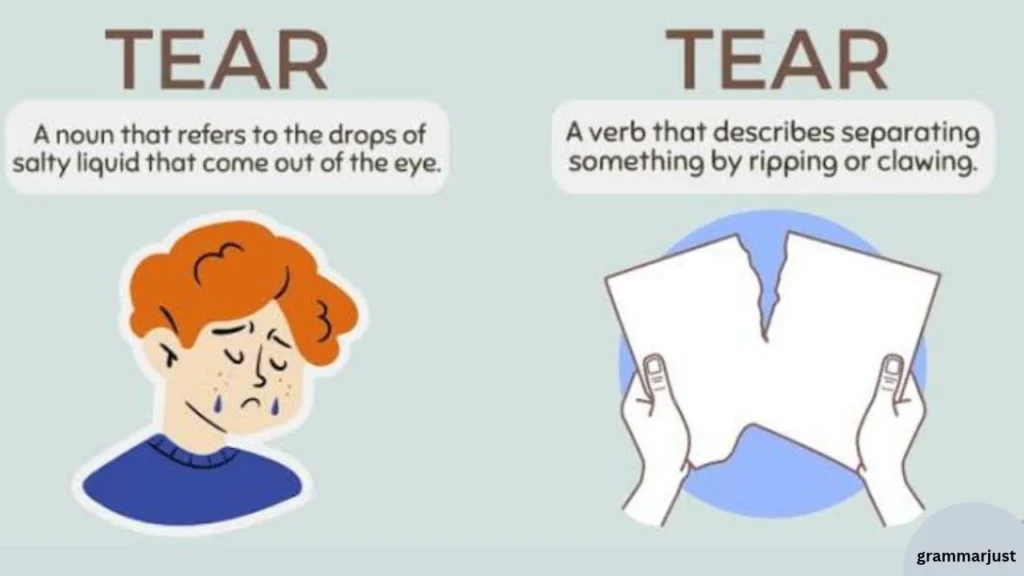
Tear vs Tear: Learn the difference between tear meaning to rip and tear meaning a drop of water.
Have you ever come across the word tear and wondered how to pronounce it? English has two words spelled exactly the same way but with different pronunciations and meanings. One refers to a drop of liquid from the eye, while the other means to rip or pull something apart.
Although their spelling is identical, their pronunciation and use are different. Understanding the context makes it easier to recognize which meaning is intended.
Tear vs Tear: What’s the Difference?
The main difference between the two forms of tear is their meaning and pronunciation.
| Word | Pronunciation | Meaning | Example |
| Tear (eye liquid) | TEER | A drop of liquid produced by the eye | A tear rolled down her cheek. |
| Tear (rip) | TAIR | To pull something apart or a rip in material | Please tear the paper in half. |
Both forms are examples of heteronyms: words that share the same spelling but have different pronunciations and meanings.
What Does Tear Mean When It Rhymes With “Air”?
Tear, pronounced like air or care, means to rip, split, or pull something apart. It can be used as either a noun or a verb.
As a verb, it describes the action of damaging or separating something by force.
Examples:
- Please tear the paper along the dotted line.
- The dog might tear the cushion if you leave it unattended.
- She had to tear open the package.
- Strong winds can tear branches from trees.
As a noun, tear refers to a rip, hole, or opening in something.
Examples:
- There is a small tear in my jacket.
- He noticed a tear in the old photograph.
- The tailor repaired the tear in her dress.
You will also encounter this meaning in expressions such as tear apart, tear down, and tear off.
What Does Tear Mean When It Rhymes With “Ear”?
The second form of tear is pronounced like ear or near. It refers to a drop of salty liquid produced by the eyes, often because of sadness, happiness, pain, or irritation.
It is commonly used as a noun.
Examples:
- A tear rolled down his cheek.
- She wiped a tear from her eye.
- The emotional speech brought tears to everyone’s eyes.
- He tried to hide his tears during the farewell.
The plural form is tears.
This meaning also appears in common expressions:
- In tears: Crying or showing strong emotion.
- Burst into tears: Suddenly start crying.
- Bring tears to someone’s eyes: Make someone emotional enough to cry.
- Tearful: Showing or expressing sadness.
The word can also function as a verb when describing eyes producing tears.
Example: My eyes tear whenever I cut fresh onions.
How Is Tear Pronounced in British and American English?
The pronunciation changes depending on which meaning you intend. British and American dictionaries use slightly different phonetic representations.
| Meaning | British English | American English |
| Tear (eye liquid) | /tɪə(r)/ | /tɪr/ |
| Tear (rip) | /teə(r)/ | /ter/ |
An easy way to remember the difference is:
- TEER: Rhymes with ear. It refers to liquid produced by the eye.
- TAIR: Rhymes with air. It refers to ripping something or a rip in material.
The exact sound can vary slightly by accent, but the two meanings remain distinguishable.
Is Tear a Noun or a Verb?
It can be both. Its grammatical role depends on how it is used in a sentence.
Tear meaning a rip:
- Noun: There is a tear in the curtain.
- Verb: Do not tear the curtain.
Tear meaning eye liquid:
- Noun: A tear fell from her eye.
- Verb: My eyes tear when I chop onions.
Look at the surrounding words to understand the intended meaning. Words such as paper, fabric, and rip usually indicate physical damage, while eyes, cheeks, and crying indicate eye-related tears.
Tear, Tore, and Torn: What Is the Difference?
When tear means to rip something, it is an irregular verb. Its main forms are:
| Verb form | Word | Example |
| Base form | Tear | I tear old papers into small pieces. |
| Past tense | Tore | She tore the envelope open. |
| Past participle | Torn | The envelope has been torn. |
| -ing form | Tearing | He is tearing the cardboard. |
Remember these two important rules:
- Use tore for a completed action in the simple past: “She tore the page.”
- Use torn with helping verbs or as an adjective: “She has torn the page.”
Avoid writing “She has tore the page.” The correct form is “She has torn the page.”
What Does “Tear Up” Mean?
The phrase tear up has different meanings depending on the context. It can refer to physically destroying something or becoming emotional.
1. Tear up something: To rip it into pieces
Example: He decided to tear up the old document.
2. Tear up: To become emotional or start producing tears
Example: She began to tear up while watching the farewell video.
The surrounding words help identify which meaning is intended. When an object such as a letter or document follows the phrase, it usually refers to ripping. When a person becomes emotional, it refers to crying.
Why Are the Two Words Spelled the Same?
The two forms of tear are examples of heteronyms. A heteronym is a word that has the same spelling as another word but a different pronunciation and meaning.
Heteronyms are a type of homograph. Homographs share the same written form but may or may not have different pronunciations.
Other English examples include:
- Lead: /liːd/ means to guide; /led/ refers to the metal.
- Wind: /wɪnd/ means moving air; /waɪnd/ means to twist or turn.
- Bow: /baʊ/ means to bend forward; /boʊ/ refers to a weapon or a decorative knot.
These examples show why English pronunciation cannot always be determined from spelling alone.
Tear vs Tare vs Tier
These three words can cause confusion because their pronunciations overlap, but they have different meanings.
| Word | Pronunciation | Meaning |
| Tear (eye) | TEER | A drop of liquid from the eye |
| Tear (rip) | TAIR | To rip something or a rip in material |
| Tare | TAIR | The empty weight of a container or adjusting a scale for that weight |
| Tier | TEER | A level, rank, or row in an arrangement |
Examples:
- Tear: A tear rolled down his face.
- Tear: She had to tear the paper.
- Tare: The tare weight of the empty box was recorded.
- Tier: The company introduced a new pricing tier.
Remember that tare is associated with weighing, while tier refers to a level or rank. Neither word is interchangeable with tear.
Common Mistakes to Avoid
Here are some common mistakes involving the two meanings of tear and related words.
1. Pronouncing both forms of tear the same way
The eye-related word rhymes with ear, while the rip-related word rhymes with air.
2. Confusing tear with tare
Incorrect: Please tare the paper in half.
Correct: Please tear the paper in half.
3. Using tore instead of torn
Incorrect: The page has tore.
Correct: The page has torn.
4. Confusing tear with tier
Incorrect: The theater has three tears of seating.
Correct: The theater has three tiers of seating.
5. Mixing up wear and tear
Wear and tear is an established expression that refers to damage caused by regular use.
Example: The furniture showed signs of wear and tear after many years.
Frequently Asked Questions
Are the two meanings of tear pronounced differently?
Yes, the word referring to eye liquid rhymes with ear, while the word meaning to rip something rhymes with air.
What are the two meanings of tear?
One meaning is a drop of liquid produced by the eye. The other means to pull something apart or refers to a rip in an object or material.
Is tear a heteronym?
Yes, the two forms of tear have the same spelling but different pronunciations and meanings, making them heteronyms.
Is tear a noun or a verb?
It can be both. The rip-related meaning is used as a noun or verb. The eye-related meaning is commonly a noun but can also function as a verb when describing eyes producing tears.
What is the past tense of tear?
When tear means to rip something, its simple past tense is tore, and its past participle is torn.
Examples: “She tore the paper yesterday” and “She has torn the paper.”
What does tear up mean?
Tear up can mean to rip something into pieces or to become emotional and start producing tears. Its meaning depends on the context.
What is the difference between tear and tare?
Tear can refer to eye liquid or the action of ripping something. Tare refers to the empty weight of a container or adjusting a weighing scale to account for that weight.
What is the difference between tear and tier?
Tear refers to eye liquid or ripping. Tier means a level, rank, or row, such as a tier of seats or a membership level.
Conclusion
The difference between the two meanings of tear comes down to pronunciation and context. The form that rhymes with ear refers to liquid produced by the eye, while the form that rhymes with air means to rip something or describes a rip.
Remembering these two sounds and practicing examples such as “a tear rolled down her cheek” and “tear the paper” will help you recognize and use each meaning correctly.
Also Read: