Steer or Stear: Correct Spelling, Meaning, and Examples
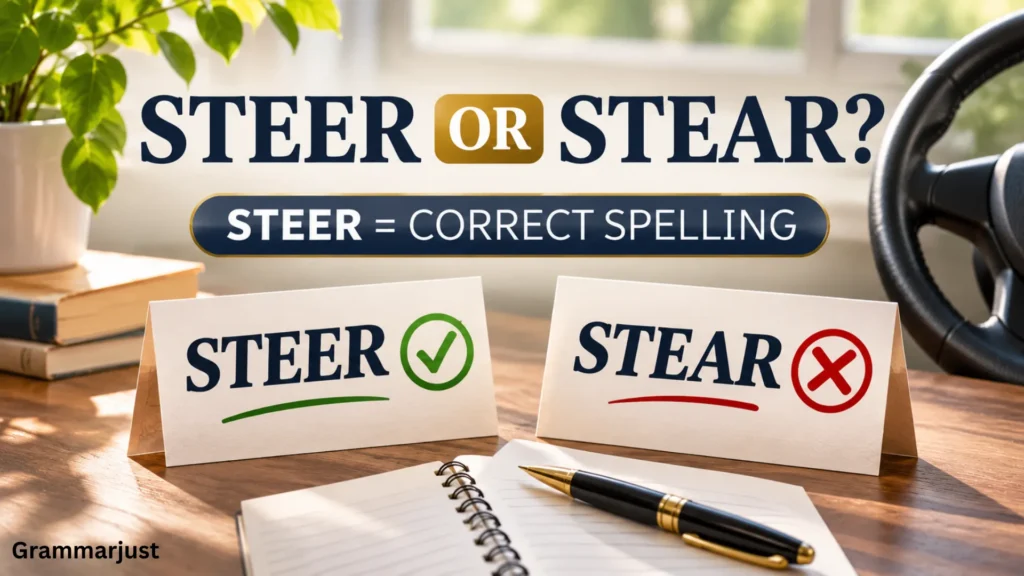
Steer is the correct modern English spelling for guiding, directing, or controlling movement.
Steer is the correct spelling when you mean to guide, direct, or control something. The word can describe turning a vehicle, guiding a conversation, or helping someone make a decision. It is also used as a noun for a male bovine animal, usually one that has been castrated.
Stear is not a standard spelling for these meanings in modern English.
For example:
- Correct: She learned to steer the boat across the lake.
- Incorrect: She learned to stear the boat across the lake.
The spelling stays the same in American and British English.
Steer vs Stear: What’s the Difference?
The confusion comes from the letters ee and ea. English uses both vowel combinations, but they are not interchangeable.
| Word | Correct Usage | Meaning |
| Steer | Standard English | To guide or direct; also a male bovine animal |
| Stear | Nonstandard for these meanings | An older spelling found in historical texts |
If your sentence involves changing direction, offering guidance, or referring to cattle, steer is the spelling you need.
What Does Steer Mean in English?
The word has several uses, depending on the situation.
1. Controlling the Direction of a Vehicle
To steer means to control where a car, boat, bicycle, or another vehicle goes.
Examples:
- Olivia steered the car into the parking space.
- The captain had to steer around the rocks.
- He struggled to steer his bicycle through the crowd.
In each sentence, someone controls the direction of movement.
2. Guiding a Person or Situation
You can also steer someone toward a choice or influence how a discussion develops.
Examples:
- Her teacher steered her toward a career in science.
- The manager steered the conversation back to the main issue.
- A helpful suggestion can steer someone away from a poor decision.
This meaning involves guidance rather than physically turning something.
3. Steer as an Animal
In farming, a steer is a male bovine animal that has usually been castrated and is often raised for beef.
Example: The farmer moved the steers into a larger field.
This meaning is unrelated to controlling a vehicle, although the spelling is identical.
The Merriam-Webster definition of steer identifies steer as both a verb for directing movement and a noun referring to a male bovine animal.
Is Stear Ever a Correct Word?
The spelling stear appears in historical sources, including older Scots writing. However, it is not used as the standard modern spelling of steer.
You may also notice similar letters in scientific terms:
- Stearic acid: A saturated fatty acid.
- Stearin: A fatty substance.
- Stearate: A salt or ester of stearic acid.
These are established scientific terms. They do not make stear an acceptable replacement for steer in everyday writing.
For schoolwork, emails, articles, and professional documents, use steer when referring to direction or guidance.
Steer Clear or Stear Clear: Correct Expression
Steer clear is the correct expression. It means to avoid something that may be dangerous, unpleasant, or troublesome.
Examples:
- Visitors should steer clear of the damaged staircase.
- I try to steer clear of unnecessary arguments.
- The doctor advised him to steer clear of activities that caused pain.
The expression comes from the idea of directing your path away from an obstacle.
It commonly appears as steer clear of followed by the person, place, or situation you want to avoid.
Writing stear clear is a spelling mistake.
Steered, Steering, and Other Word Forms
The double-e spelling remains consistent when the verb changes form.
| Word Form | Example |
| Steer | Please steer carefully on this road. |
| Steers | She steers the discussion toward useful solutions. |
| Steered | We steered the boat toward the shore. |
| Steering | He was steering when the storm began. |
Two common mistakes are stearing and steared. Their correct forms are steering and steered. A simple way to remember the spelling is to connect steer with a steering wheel. Both words contain the same double-e pattern.
Small vowel changes can cause spelling mistakes in other English words, too. A similar example appears in our explanation of separate vs seperate.
FAQs
Is It Steer or Stear a Car?
Steer a car is correct. The verb means to control the direction in which a vehicle moves.
Is Stear a British English Spelling?
No, modern British and American English both use steer. The spelling does not change between these varieties.
What Is the Past Tense of Steer?
The past tense is steered. For example, “She steered the bicycle around the fallen branch.”
Can Steer Mean Advice?
Yes, in some contexts, especially informal British English, a steer can mean a useful hint or piece of advice.
For example: “Could you give me a steer on which option to choose?”
How Is Steer Pronounced?
Steer has one syllable. Its pronunciation varies slightly by accent: /stɪr/ in American English and /stɪə/ in standard British dictionary pronunciation.
Final Thoughts
Choose steer whenever you are writing about controlling direction, guiding someone, or referring to the animal. The same spelling appears in steering, steered, and steer clear.
Although stear can be found in historical writing, it is not a standard alternative in modern everyday English.


1 thought on “Steer or Stear: Correct Spelling, Meaning, and Examples”