Orientated vs Oriented: Which Form Fits Your Writing?
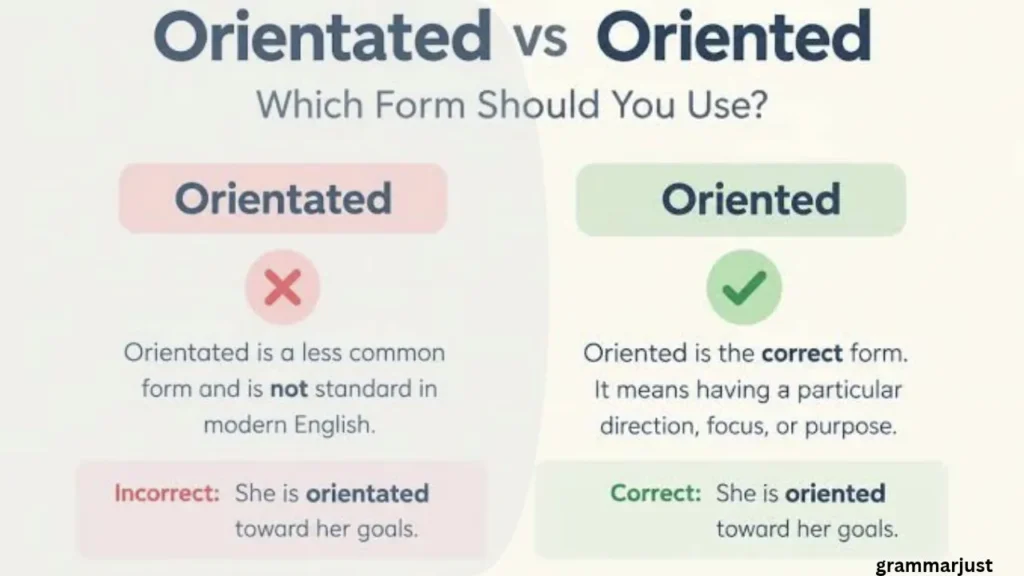
Understand the difference between orientated and oriented and learn when to use each spelling.
Have you ever wondered whether to write orientated or oriented? Both spellings appear in English, which can make it difficult to know which one to choose. The good news is that neither is grammatically incorrect.
Oriented is the more widely recognized form, particularly in American English, while orientated is especially associated with British English. Both words generally describe something positioned, directed, or focused toward a particular place, purpose, or situation.
Let’s explore their meanings, regional differences, examples, and the best way to use each form.
Quick Answer: Orientated vs Oriented
Both oriented and orientated are correct English words with essentially the same meaning. The main difference is regional preference.
| Word | Common usage | Example |
| Oriented | American English and international writing | She is highly goal-oriented. |
| Orientated | Particularly associated with British English | The course is orientated toward beginners. |
Which should you choose?
- Use oriented when writing for an American or international audience.
- Use orientated when it suits British English conventions or your intended publication’s style.
- Keep your spelling consistent throughout the same document.
What Does Oriented Mean?
Oriented is the past tense and past participle of the verb orient. It can also function as an adjective.
It describes someone or something that has been positioned, directed, or adjusted toward a particular direction, environment, interest, or objective.
For example:
- The house is oriented toward the mountains.
- She is a highly career-oriented professional.
- The training program is oriented toward practical skills.
- New employees were oriented to the company’s procedures.
In these sentences, the word communicates direction, focus, or familiarity with a particular situation.
It is also frequently used in compound adjectives, including goal-oriented, customer-oriented, and detail-oriented.
What Does Orientated Mean?
Orientated is the past tense and past participle of the verb orientate. It is also used as an adjective.
Its meaning is essentially the same as oriented. It can describe something positioned in a particular direction or someone who has become familiar with a new environment or situation.
For example:
- The building is orientated toward the south.
- The students were orientated to their new classroom.
- The business is strongly orientated toward customer satisfaction.
- The course is orientated toward developing practical skills.
This spelling is particularly associated with British English, although its use is not restricted to the United Kingdom.
What is the Difference Between Oriented and Orientated?
The main difference is not their meaning but their regional usage and the verbs from which they are formed.
Both words can describe direction, position, purpose, or familiarity with an environment.
Consider these examples:
Using oriented:
The new employee was oriented to the company’s working procedures.
Using orientated:
The new employee was orientated to the company’s working procedures.
Both sentences communicate the same idea. The choice depends largely on the variety of English being used.
Here is a closer comparison:
| Comparison | Oriented | Orientated |
| Correct spelling | Yes | Yes |
| Main verb | Orient | Orientate |
| General meaning | Directed or adjusted | Directed or adjusted |
| Regional association | Particularly American and international | Particularly British |
| Suitable for formal writing | Yes | Yes, where appropriate |
| Common compound form | Goal-oriented | Goal-orientated |
The important point is that you are choosing between two accepted forms, not between a correct and an incorrect word.
Oriented vs Orientated in American and British English
Regional spelling preferences are one of the biggest reasons these words cause confusion.
American English
American English generally favors oriented.
It is the familiar choice in business documents, academic writing, workplace communication, and everyday conversation.
Examples:
- The company has a customer-oriented approach.
- He is a highly detail-oriented employee.
- The program is oriented toward young learners.
- The new staff members were oriented to their responsibilities.
Although orientated exists in English, it is much less established in everyday American usage.
British English
British English uses both forms, with orientated having a particularly strong regional association.
However, oriented is also widely understood and used by British writers.
Examples:
- The organization is customer-orientated.
- The training was orientated toward practical experience.
- She has a career-oriented approach to her work.
- The building is oriented toward the coastline.
The choice may depend on personal preference, publication style, and the language conventions being followed.
Remember: British English does not require you to use orientated in every situation. Oriented is also acceptable.
Orient vs Orientate: Understanding the Verb Forms
To understand why both spellings exist, it helps to look at their original verbs.
There are two related forms:
1. Orient → Oriented
The shorter verb orient produces the past tense and past participle oriented.
Examples:
- I need to orient myself before starting the assignment.
- The teacher oriented the new students.
- We have oriented our services toward local businesses.
2. Orientate → Orientated
The alternative verb orientate produces orientated.
Examples:
- The instructor helped orientate the new employees.
- The students were orientated before their first lesson.
- The organization has orientated its services toward younger customers.
Both verb forms are recognized in English. The choice generally reflects regional usage rather than a difference in meaning.
Other related forms follow the same pattern:
| Shorter form | Alternative form |
| Orient | Orientate |
| Oriented | Orientated |
| Orienting | Orientating |
| Disoriented | Disorientated |
| Reoriented | Reorientated |
The noun orientation remains the same.
Common Expressions: Goal-Oriented, Customer-Oriented and More
These words frequently appear in compound adjectives that describe someone’s priorities or the main purpose of something.
Here are some common expressions.
Goal-Oriented vs Goal-Orientated
Both expressions describe someone who concentrates on achieving specific objectives.
Examples:
- She is a goal-oriented student.
- He has a goal-orientated approach to business.
Goal-oriented is generally the more widely recognized form, especially in American English.
Customer-Oriented vs Customer-Orientated
These expressions describe a business that prioritizes the needs and satisfaction of its customers.
Examples:
- Our company follows a customer-oriented strategy.
- The organization has developed a customer-orientated service model.
Detail-Oriented vs Detail-Orientated
Both expressions describe someone who pays close attention to small details.
Examples:
- We need a detail-oriented editor for this project.
- The company is looking for a detail-orientated employee.
Family-Oriented vs Family-Orientated
These expressions describe someone, an activity, or an organization that places importance on family life.
Examples:
- They are a family-oriented couple.
- The community center organizes family-orientated activities.
Career-Oriented vs Career-Orientated
These expressions describe someone who gives considerable attention to professional development and career goals.
Examples:
- She is a career-oriented individual.
- He prefers a career-orientated working environment.
In each case, both constructions can be acceptable. The more familiar choice depends on the audience and regional convention.
Are Oriented and Orientated Pronounced Differently?
Yes. The two forms have slightly different pronunciations because orientated contains an additional syllable.
- Oriented: commonly pronounced as three syllables: OR-ee-en-tid.
- Orientated: commonly pronounced as four syllables: OR-ee-en-TAY-tid.
Pronunciation can vary slightly between accents.
If you are learning English, listening to both pronunciations can help you recognize the difference when speaking and reading.
Should You Use a Hyphen With Oriented and Orientated?
Hyphenation is common when these words form compound adjectives before a noun.
For example:
- She is a detail-oriented writer.
- We need a customer-oriented business strategy.
- He follows a goal-orientated approach.
- The organization offers family-oriented services.
When the expression comes after the noun, the hyphen may be omitted depending on the style being followed.
For example:
- Her approach is detail oriented.
- Their business is customer oriented.
However, many publications retain the hyphen for consistency and readability.
If you are writing for a university, employer, or publication, follow its preferred style guide.
Common Mistakes to Avoid
Understanding the regional differences can help you avoid several common writing mistakes.
1. Assuming orientated is incorrect
Orientated is an established English word. It should not automatically be treated as a spelling mistake.
2. Assuming oriented is exclusively American
Oriented is also used in British English. It is not restricted to American writers.
3. Mixing both forms unnecessarily
Avoid switching between oriented and orientated without a reason in the same document. Choose a consistent style.
4. Confusing the two verb forms
Remember the correct relationships:
- Orient → Oriented
- Orientate → Orientated
5. Ignoring your intended audience
If your readers primarily use American English, oriented will generally sound more familiar. For British readers, orientated is also a natural option.
Which Word Should You Use in Your Writing?
The best choice depends on the people who will read your work.
Here is a simple decision guide:
| Your writing situation | Recommended choice |
| American audience | Oriented |
| International audience | Oriented |
| British English publication | Either, according to its style |
| Academic writing | Follow the institution’s style guide |
| Professional documents | Oriented is a broadly recognized choice |
| Existing British English text | Orientated can be retained |
If you are uncertain, oriented is generally the safer choice for international communication.
However, there is no need to replace orientated in an otherwise consistent British English document.
Frequently Asked Questions
Is orientated a real word?
Yes, Orientated is a legitimate English word derived from the verb orientate. It is particularly associated with British English and has essentially the same meaning as oriented.
Is oriented or orientated correct?
Both are correct. Oriented is the more widely recognized form, while orientated is especially common in British English.
Is orientated British or American English?
Orientated is particularly associated with British English. American English generally prefers oriented, although orientated is also a recognized word.
Is oriented more common than orientated?
Oriented is generally more widely used, especially in American English and international professional writing. However, the relative frequency varies across English-speaking regions.
Do oriented and orientated have different meanings?
No, significant difference in meaning exists in their usual usage. Both can describe something positioned, directed, or focused toward a particular purpose or direction.
Is goal-orientated grammatically correct?
Yes, goal-orientated is an accepted expression, particularly in British English. Goal-oriented is the more widely recognized alternative in American and international writing.
Should I write customer-oriented or customer-orientated?
Both are acceptable. Customer-oriented is generally the safer choice for American and international audiences, while customer-orientated is also appropriate in British English.
Can I use orient instead of orientate?
Yes, orient is an established verb that means to position, direct, or help someone become familiar with a situation. It is particularly preferred in American English.
Are oriented and orientated pronounced the same?
No, oriented is commonly pronounced with three syllables, while orientated has four. Pronunciation may vary slightly depending on the speaker’s accent.
Is orientated acceptable in formal writing?
Yes, it can be used in formal British English writing. The important thing is to follow the relevant publication or institution’s language conventions.
Final Thoughts
When choosing between orientated vs oriented, remember that both forms are grammatically acceptable and generally communicate the same meaning.
The main distinction is regional preference. Oriented is widely recognized and particularly common in American and international writing, whereas orientated has a stronger association with British English.
If you are writing for an international audience, oriented is usually the simplest choice. If you are following British English conventions, orientated is perfectly acceptable.
Ultimately, choose the form that suits your readers and use it consistently throughout your writing.
Also Read:


1 thought on “Orientated vs Oriented: Which Form Fits Your Writing?”