Eying or Eyeing: Which Spelling Is Correct?
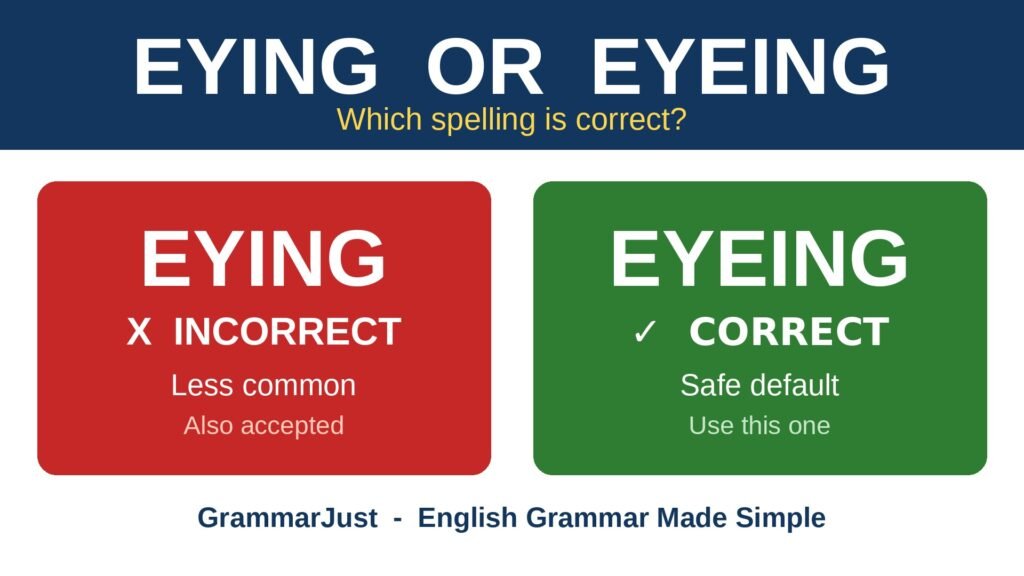
Both eying and eyeing are correct, but eyeing is the safe default.
Both spellings are correct. Eyeing and eying are two spellings of the same word, with the same meaning and the same sound. If you need one safe choice, use eyeing. It is more common, and the full word eye stays visible inside it. Eying is also accepted by dictionaries, but it is just less common. Cambridge Dictionary lists the -ing form of eye as “eyeing or eying.” Merriam-Webster lists both forms too. So this is a choice, not a right-or-wrong test.
Eying or Eyeing: The Quick Answer
Use eyeing by default in school, office and formal writing. Eying is also correct. Use it only if a style guide asks for it, or in an exact quote. Meaning: looking at someone or something closely, with interest, desire, suspicion or a plan. Pronunciation: both sound the same: EYE-ing, /aɪ.ɪŋ/. Stay consistent: pick one spelling and use it through the whole text.
What Does Eyeing Mean?
Eyeing means looking at someone or something closely, with a reason behind the look. It is not plain seeing. You see a thing when your eyes notice it. You eye it when your mind is working too; you want it, you doubt it, or you are planning your next step. That reason is usually one of four: interest or desire, suspicion, careful checking, or considering a move; for example, eyeing a new job. The sentence around the word shows which one fits. The spelling never changes it.
What Does Eying Mean?
Eying means exactly the same thing. It is not a different word, and it has no different meaning. It is the same -ing form of eye, written without the final e: ey + ing. Eyeing keeps the full word: eye + ing. That is the only difference.
Eyeing vs. Eying: Key Differences at a Glance
| Point | Eyeing | Eying |
|---|---|---|
| Correct? | Yes | Yes |
| Meaning | Looking with attention | Looking with attention |
| Built from | eye + ing (e kept) | ey + ing (e dropped) |
| Pronunciation | EYE-ing /aɪ.ɪŋ/ | EYE-ing /aɪ.ɪŋ/ |
| Grammar | Present participle or gerund | Present participle or gerund |
| How common? | More common | Less common |
| Best for | Default choice | House style or a quote |
Only two rows differ: how the word is built, and how often people use it. Meaning, grammar and sound are the same.
Why Are Both Spellings Accepted?
Most verbs ending in a silent e drop that e before -ing: make → making, write → writing, hope → hoping. By that rule, eye should become eying, and it can. That is why dictionaries accept eying. But eye is a short word made almost only of vowels: e-y-e. Drop the last e and the base word nearly disappears, so eying looks odd to many readers. English therefore also kept eyeing, where eye stays clear at a glance. Both forms became established, and neither died out. Keeping the e can also protect meaning; compare dyeing (colouring cloth) with dying (losing life). A spelling rule is a guide, not a judge: when trusted dictionaries list two forms, both are real. To see the same pattern in another verb, read Tying or Tieing.
Is Eyeing or Eying More Common?
Eyeing is more common. It is the form most books, news sites, teachers and editors use, and the one most readers recognise at once. Eying is correct but uncommon. A reader who has never seen it may pause and think it is a typo, even though it is not. That pause is the practical reason to prefer eyeing.
Eyeing vs. Eying in American and British English
This pair does not split cleanly by country, like color (US) and colour (UK). Cambridge marks eying as a form also used in US English. That means it is accepted in American writing, not that Americans prefer it. In practice, eyeing is the normal default in the US too, and British writers also use eyeing as their default. So the advice is the same in both countries: use eyeing, unless a style guide says otherwise, and keep the original spelling inside a direct quote.
Eyeing in a Sentence: 10 Clear Examples
All 10 use eyeing, the default spelling. You can swap in eying in any of them; the meaning will not change.
- The kids were eyeing the ice cream truck long before it stopped.
- Ahmed has been eyeing that camera for weeks, waiting for the price to drop.
- The guard was eyeing every bag that came through the gate.
- She was eyeing the email with doubt; the offer looked too good to be true.
- The two shop owners eyed each other in silence. (Past form: eyed.)
- After three years in the same role, Sara is eyeing a team lead position.
- The small bakery is eyeing a second shop in the city centre.
- The mechanic spent a minute eyeing the engine before touching a tool.
- He kept eyeing the clock during the test.
- Two buyers were eyeing up the same house, so the price rose fast.
The last example shows the common phrase eyeing up: looking closely because you are interested in something.
When Should You Use Eyeing in Everyday and Formal Writing?
| Where | Use | Why |
|---|---|---|
| School, college, exams | Eyeing | The form teachers expect. |
| Office email or report | Eyeing | Clear and professional. |
| Blog or website | Eyeing | Readers recognise it at once. |
| Formal writing | Eyeing | Safest, most standard form. |
| Everyday writing | Eyeing | No reason to risk doubt. |
| House style or exact quote | Eying, if specified | Follow the guide or keep the quote exact. |
In short: eyeing fits almost every situation. Eying needs a specific reason, such as a house rule or someone else’s exact words.
Common Spelling Mistakes to Avoid
1. Assuming eying is always wrong
It is not. Dictionaries list eying as an accepted spelling. Calling it an error is itself a mistake; it is only less common than eyeing.
2. Assuming the words have different meanings
They do not. Eyeing and eying both mean looking closely with interest, desire, suspicion or a plan. Context sets the tone, never the extra e.
3. Switching between both forms unnecessarily
Using eyeing in one paragraph and eying in the next looks like careless editing, even though both are correct. Choose one form at the start and keep it to the end.
4. Confusing eyeing with eyed
Eyed is the past form: “She eyed the stranger.” Eyeing is the -ing form: “She is eyeing the stranger.” “She is eyed the stranger” is always wrong.
5. Treating regional labels as absolute rules
Cambridge’s “US also” label for eying does not mean British writers must never use it, or that Americans must prefer it. It is a note about use, not a strict rule.
Eyeing vs. Eyed vs. Eye
| Form | Type | Example |
|---|---|---|
| eye | Base verb | I eye every offer with care. |
| eyes | Verb with he, she or it | She eyes the door nervously. |
| eyed | Past tense or past participle | He eyed the stranger and said nothing. |
| eyeing / eying | -ing form | She is eyeing the last seat. |
Remember the split: eyed is for a finished, past action. Eyeing is for an action in progress, or used as a noun, as in “Eyeing the prize kept him focused.”
Easy Tricks to Remember the Spelling
Keep the eye in eyeing. If you can still see the full word eye inside it, you have the default spelling right: eye + ing = eyeing. When in doubt, keep the e. If a word looks too short to be the word you mean, it probably is. Eying is correct, but eyeing is the form readers trust. One text, one spelling. Say it once, write it one way. Decide before you start, then do not switch.
People Also Ask
Is eying a real word?
Yes. Cambridge lists the -ing form of eye as “eyeing or eying,” and Merriam-Webster lists both. Eying is less common than eyeing, but less common does not mean wrong.
Is eyeing the correct spelling?
Yes, and so is eying. If you have no style guide to follow, choose eyeing. It is more common, accepted everywhere, and readers see the word eye inside it at once.
How do you pronounce eyeing and eying?
The same way: EYE-ing, /aɪ.ɪŋ/, in two syllables. Say eye, then add -ing. The extra e in eyeing adds no extra sound.
Does eying mean something different from eyeing?
No. Both mean looking at someone or something closely, with interest, desire, suspicion or a plan. The words around the verb set the exact tone.
What is the past tense of eye?
Eyed. For example: “She eyed the report then signed it.” Use eyed for a past action and eyeing for an action in progress.
Which spelling is better for formal writing?
Eyeing. It is the form most editors and teachers expect, so it is the safe choice for essays, reports and applications. If a style guide lists eying, follow the guide and stay consistent.
Conclusion
Both eying and eyeing are correct, mean the same thing, and sound the same. Eying follows the normal rule of dropping the final e; eyeing keeps the e so the word eye stays clear, and it is the spelling most people use. Write eyeing by default, accept eying when you see it, and never mix the two in one text. That is the whole rule.
2 thoughts on “Eying or Eyeing: Which Spelling Is Correct?”